
Application Scenarios and Scientific Material Selection Guide for PA66 Thermal Break Strips with Different GF Contents
As the performance requirements for PA66 thermal barrier strips continue to diversify in the construction and industrial sectors, products with three glass fiber contents — GF20, GF30 and GF40 — have gradually formed a differentiated application landscape. The glass fiber content dictates the core performance characteristics of each product, while the stress conditions, environmental requirements and cost budgets of application scenarios govern the selection criteria for glass fiber content. Based on the performance attributes of these three specifications and combined with mainstream application scenarios in construction and industry, this paper conducts precise market segmentation and provides scientific material selection guidelines. It helps industry practitioners avoid common mistakes in material selection, achieve the application goals of optimal performance matching and cost control, and promote the rational and refined application of PA66 thermal barrier strips.
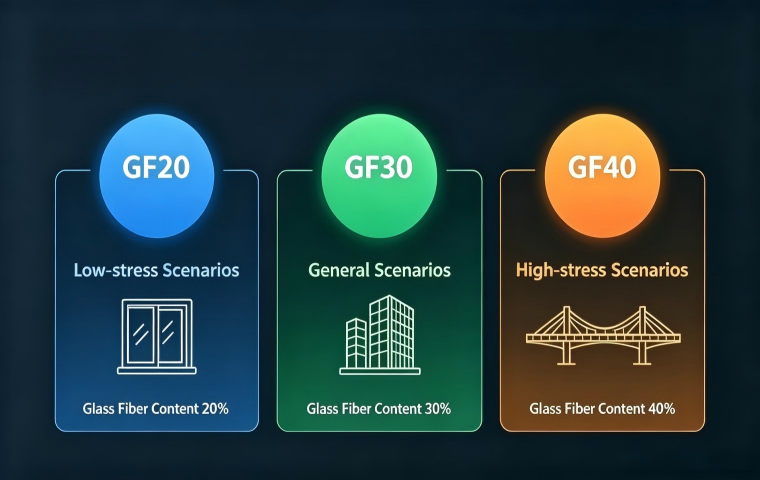
PA66GF20 (glass fiber content: 20%±2%) features outstanding toughness, easy processability and cost efficiency as its core strengths. It is mainly applied to mid-to-low-end scenarios with moderate strength requirements and high demands for toughness and processing efficiency, primarily including residential decoration, small civil buildings and simple industrial equipment.For residential decoration, PA66GF20 is suitable for casement windows and sliding windows in ordinary residences. Windows in such scenarios bear low stress, with basic thermal insulation and structural stability as the main demands. PA66GF20 fully complies with the basic requirements of GB/T 5237.6-2017. Its excellent toughness prevents breakage caused by collision during installation and service. Meanwhile, its superior fluidity improves production efficiency and helps window and door manufacturers cut procurement and production costs.When used for simple industrial equipment, it serves as thermal insulation components for small machinery. These applications impose low stress on thermal barrier strips and prioritize easy processing and cost control, where PA66GF20 delivers prominent cost-performance advantages.
In terms of material selection guidelines, priority shall be given to the toughness and processing quality of PA66GF20 to guarantee its qualified impact resistance, with the unnotchedimpact strength no less than 12 kJ/m². It is necessary to prevent insufficient strength caused by inadequate glass fiber content. Meanwhile, inspect product test reports to confirm that the PA66 resin is virgin material without recycled admixtures, and the glass fiber is evenly distributed so as to avoid local performance defects resulting from fiber agglomeration. Furthermore, this product is not applicable to heavily loaded scenarios such as large-size doors and windows and curtain walls of high-rise buildings, which may lead to potential quality risks including deformation and fracture.
PA66GF30 (glass fiber content: 30%±2%) features balanced strength and toughness, excellent dimensional stability and wide adaptability. It has become the mainstream choice in the construction and industrial sectors, suitable for mid-to-high-end home decoration, doors and windows of high-rise buildings, medium-sized industrial equipment and other scenarios.In mid-to-high-end home decoration, it is applied to French windows and balcony sliding doors in villas and premium residences. Doors and windows of large sizes in these scenarios need to bear greater glass load and wind pressure. The high strength and creep resistance of GF30 ensure structural stability, while its good toughness prevents brittle fracture at low temperatures, making it adaptable to various climates across northern and southern China.For doors, windows and small curtain walls of high-rise buildings, GF30 boasts prominent advantages in dimensional stability and thermal expansion coefficient. Its thermal expansion coefficient is highly compatible with aluminum alloy profiles, which effectively prevents separation between profiles and thermal barrier strips due to temperature changes, and guarantees the sealing performance and service life of doors, windows and curtain walls.In medium-sized industrial equipment, it is used for equipment housings and pipeline thermal insulation components that withstand certain mechanical loads and thermal stress. The well-balanced overall properties of GF30 meet the requirements for long-term stable operation.
In terms of material selection for PA66GF30, focus on its strength and dimensional accuracy. The longitudinal tensile strength shall be no less than 85 MPa, flexural strength no less than 130 MPa, and cross-sectional dimensional tolerance shall be within ±0.1 mm for a precise fit with profile grooves. Besides, check the uniformity of glass fiber distribution and weather resistance. The product shall be blended with sufficient weathering agents and antioxidants to adapt to harsh outdoor conditions, with strength retention rate above 85% after damp-heat aging and UV aging tests. Offering excellent cost performance that balances performance and cost, it is the top choice for most mid-to-high-end application scenarios.PA66GF40 (glass fiber content: 40%±2%) is characterized by high strength, high rigidity and superior dimensional stability. It is mainly used for special scenarios with extremely high mechanical performance requirements, including curtain walls of super high-rise buildings, heavy-duty industrial equipment and thermal insulation components for high-temperature environments.Curtain walls of super high-rise buildings are subject to long-term strong wind load, seismic load and thermal stress. The high strength and creep resistance of PA66GF40 prevent deformation and fracture of thermal barrier strips, securing the structural safety of curtain walls. Its low thermal conductivity further improves the energy-saving performance, helping super high-rise buildings comply with green energy efficiency standards. When applied to heavy-duty industrial equipment, it serves as load-bearing thermal insulation parts and protective components for high-temperature pipelines. Able to withstand heavy mechanical loads and high temperatures, its high rigidity and thermal stability ensure long-term reliable operation and avoid equipment malfunctions caused by material failure.
When selecting PA66GF40, priority should be given to its strength, rigidity and processing quality. Given its high glass fiber content, this material is difficult to process. It is recommended to cooperate with manufacturers with mature production techniques to ensure the finished products are free from defects such as exposed glass fibers, air bubbles and deformation. Meanwhile, check the test reports for impact resistance and low-temperature brittleness to prevent brittle fracture in low-temperature environments.
In addition, this product features higher costs and longer processing cycles. It should be selected rationally according to actual application demands to avoid unnecessary cost waste caused by excessive pursuit of ultra-high strength. It is recommended primarily for special scenarios that endure extreme stress and require superior material performance.
In conclusion, PA66 thermal barrier strips with different glass fiber contents have no absolute advantages or disadvantages. The key lies in precise matching with actual application scenarios. PA66GF20 is suitable for mid-to-low-end applications with low load; PA66GF30 fits mid-to-high-end and general-purpose scenarios; PA66GF40 is ideal for special occasions under heavy load.Scientific material selection shall take into account on-site stress conditions, environmental requirements, cost budgets and product performance indicators. Avoid the misconceptions of blindly choosing products with high glass fiber content or simply picking low glass fiber content just to cut costs, so as to guarantee favorable application performance and long-term stability of PA66 thermal barrier strips.