
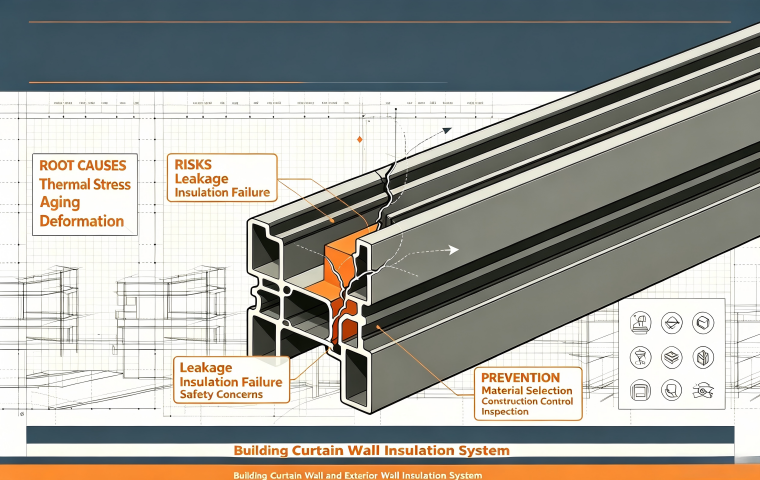
The core cause of the cracking of the insulation strip
During the long-term use of broken-bridge aluminum doors and windows, the cracking of the insulation strips is the main cause leading to the scrapping of the doors and windows, project rework, and after-sales rights protection issues. Many people mistakenly believe that the cracking of the insulation strips is solely caused by improper installation. In fact, over 90% of the cracking problems stem from four core factors: inherent material defects, uncontrolled production processes, internal injuries from storage and transportation, and imbalance in compatibility with the working conditions. Improper assembly is only an inducement, not the root cause. This article deeply analyzes the underlying causes of insulation strip cracking and the associated engineering hazards, and simultaneously provides a comprehensive prevention plan for the entire production, procurement, assembly, and usage process. It aims to offer professional references for the industry to completely solve the problem of insulation strip cracking.
1. Four core causes leading to the cracking of insulation strips
First, the material is inherently impure, with a failure in the balance between rigidity and flexibility (the main reason). The brand-new PA66GF25 insulation strip has a balanced rigidity and flexibility, and is less prone to cracking. However, the low-priced products on the market are often mixed with recycled materials, PA6 impurities, and excessive calcium carbonate fillers. The molecular chains of the material break, the distribution of glass fibers becomes disorderly, and the toughness is significantly reduced, while the brittleness increases sharply. These insulation strips may seem to have a normal appearance, but their internal structure is actually fragile. Even slight stress or temperature changes can cause cracking, making this the core reason for frequent cracking in engineering applications.
Second, the production process was out of control, resulting in latent internal damage. The excessively high extrusion temperature led to thermal degradation of the PA66 material, damaging its molecular structure; poor vacuum exhaust caused internal looseness and cavities, creating stress weak points; the dulling of the cutting blades and excessive cutting speed led to invisible micro-cracks at the ports; uneven mixing and imbalanced proportions caused inconsistent hardness in certain areas, resulting in concentrated cracking under force. The latent cracks caused by the production process defects will gradually manifest over several months to several years of the door and window usage.
Thirdly, improper storage and assembly can lead to external damage. When the insulation strips are stacked too high, subjected to heavy pressure and squeezing, bent and stored, or dragged and loaded, permanent and latent deformations and internal injuries will occur; when the strips are assembled by forced compression, interference fit, or manually forcefully correcting the bending of the insulation strips, a large amount of internal stress will accumulate. Later, under the action of thermal expansion and contraction, the stress will be released, directly tearing the profiles and causing cracks.
Fourth, the aging of working conditions is unbalanced, accelerating fatigue cracking. Long-term exposure to high temperatures, erosion by rainwater, and significant temperature fluctuations throughout the year can cause the thermal aging of inferior insulation strips to accelerate, the material to become brittle, and the anti-fatigue performance to continuously deteriorate; continuous wind pressure vibrations in high-rise buildings cause the insulation strips to remain in a constantly alternating stress state for a long time, eventually leading to fatigue cracking.
2. Chain Engineering Hazards Caused by Cracking of Insulation Strips
As the core structural component and insulation part of the insulated aluminum window, once the insulation strips crack, it will lead to a triple failure in terms of structure, energy conservation, and safety.
At the structural level, cracking directly damages the overall force-bearing system of the doors and windows. The insulation strips are unable to perform the functions of supporting, buffering, and resisting deformation. The aluminum profiles lose their balanced support, resulting in deformation of the window sashes, distortion of the frames, and loosening of the joints, leading to difficulties in opening and closing the doors and windows, poor sealing, and abnormal shaking and noise, seriously affecting the functionality.
In terms of energy conservation, the cracks and fissures will form a transparent channel for cold and hot air convection, completely blocking the heat insulation function of the insulation strips. The cold and heat bridge phenomenon of doors and windows will intensify, and the insulation and soundproofing performance will significantly decline. It will fail to meet the building energy-saving acceptance standards, and problems such as cold in winter and hot in summer, and noise penetration will occur.
In terms of safety, the large-scale cracking and breaking of the insulation strips cannot withstand strong wind pressure and external impacts. There is a potential risk of the profiles of high-rise building doors and windows loosening and partially falling off. This not only significantly shortens the service life of the doors and windows but also poses serious engineering safety hazards.
3. Fine-grained Control Plan for Full-Process Cracking Defects
At the raw material stage, strict control is exercised over the purity of the materials to prevent the inclusion of recycled materials, impurities, excessive fillers, and adhere to the standard formula of 100% new PA66 + 25% glass fiber, ensuring a balance between rigidity and toughness, thereby eliminating the potential risk of brittle cracking at its source.
The production end standardizes process parameters, precisely controls extrusion temperature, vacuum exhaust, mixing ratio, and cutting accuracy, avoiding internal injuries such as melt degradation, internal porosity, and port micro-cracks during the process, ensuring that the internal structure of the profiles is dense and the load distribution is uniform.
The storage and transportation end should be properly arranged for loading and unloading. It is prohibited to stack or store with excessive pressure, bend or drag forcefully. The products should be kept straight and orderly, and any hidden deformation or stress damage during storage and transportation should be strictly avoided.
Standardized assembly construction is carried out, prohibiting forced threading, violent correction, and interference compression. Reasonable assembly clearance is ensured, and artificial accumulation of assembly stress is avoided. This reduces the probability of cracking at the usage end.
4. Core Value of Crack Prevention in the Industry
The cracking of insulation strips is the ultimate weakness in the quality of doors and windows, and it is also a typical quality issue resulting from the industry's low-price and low-quality competition. Establishing a full-process crack prevention system, controlling from multiple dimensions such as materials, processes, storage, and assembly, can completely eliminate crack defects and ensure the stability, energy-saving longevity, and safety and durability of the break-through aluminum doors and windows. For door and window enterprises, paying attention to the root cause of crack prevention is a key measure to enhance product core competitiveness, reduce after-sales costs, establish project reputation, and is also an inevitable trend for promoting the high-quality and standardized development of the industry.
Conclusion
The cracking of the insulation strips is not merely a single usage issue; rather, it is a comprehensive quality problem involving the material, process, storage, and assembly. Inadequate material purity, uncontrolled process, and improper force application can all lead to irreversible structural cracking. The industry should abandon the misconception that "cracking is a minor issue" and establish zero-cracking quality control standards. From the source, it is necessary to control the material and process, and implement precise management throughout the entire process to completely eliminate the potential risks of insulation strip cracking and ensure the quality and long-term service safety of the insulated aluminum window projects.