
Weather‑resistant Failure, Accelerated Aging And Cascading Engineering Hazards of Thermal‑insulation Strips Caused by Impure Raw Materials
This paper investigates the performance failures of PA66 thermal insulation strips caused by impure raw materials commonly used in the industry. Compared with pure virgin PA66 featuring stable structure and over 20-year service life, strips blended with recycled materials and inferior fillers suffer severe structural defects, including accelerated thermal-ultraviolet aging, hydrolysis deterioration and temperature fatigue failure. Such defects lead to premature aging, structural fracture, failed building energy conservation and hidden engineering safety hazards. This study verifies that strict raw material purification and standardized virgin PA66 production are essential to guarantee long-term durability and stabilize the quality of thermal-break window systems.
If the first article elaborated on the damage of impure raw materials to the short‑term physical and basic mechanical properties of thermal‑insulation strips, then under long‑term working conditions, the greatest hazards brought by impure raw materials are reflected in the comprehensive collapse of weather resistance, thermal‑oxidative aging resistance, hydrolysis resistance and anti‑fatigue service life. Many thermal‑insulation strips seem normal in appearance and strength at the initial stage of commissioning, yet they rapidly turn yellow, chalk, crack, peel off and fail after two to three years of service. The root cause is not harsh operating conditions, but the congenital deficiency of long‑term durability resulting from impure raw materials. Thermal‑insulation strips made from impure raw materials feature extremely poor aging resistance, low temperature tolerance, severe moisture‑induced hydrolysis and very short fatigue life, which cannot meet the decades‑long service requirements of doors and windows. This paper deeply analyzes the damage mechanism, failure process and engineering hazards of impure raw materials to the long‑term performance of thermal‑insulation strips, and puts forward optimization schemes for raw‑material quality control.
I. Impure raw materials greatly accelerate the rates of thermal‑oxidative aging and ultraviolet aging
Pure virgin PA66 has a stable molecular structure and excellent resistance to thermal oxidation and ultraviolet radiation, aging slowly under long‑term exposure to sunlight and high‑temperature heat accumulation. In contrast, impure raw materials blended with recycled material, foreign material and inferior fillers contain a large number of chain‑broken molecules, active impurities and easily oxidized groups, which undergo rapid oxidative degradation under the action of high temperature, light and oxygen. Impurity particles become breakthrough points for aging, continuously inducing yellowing, chalking and surface peeling of the material.
Engineering data show that standard thermal‑insulation strips made of pure material can serve stably for more than 20 years without obvious aging; under outdoor exposure conditions, thermal‑insulation strips made of impure raw materials can obviously turn yellow and become brittle within 1 to 2 years, and suffer comprehensive aging failure within 3 to 5 years. Their service life is less than one‑third of that of genuine products, which is a typical case of premature short‑term failure.
II. Impurities and recycled materials cause overall deterioration of hydrolysis resistance and moisture resistance
The hydrolysis‑resistant and moisture‑proof performance of thermal‑insulation strips is critical under working‑condition environments such as plum‑rain seasons in southern China, coastal salt spray, exterior‑wall condensation and rain exposure. Pure PA66 features a dense material structure, low water‑absorption rate, slow hydrolysis speed and stable performance during dry‑wet cycles. Impure raw materials contain abundant internal micropores and impurities with large interfacial gaps, so moisture vapor can easily penetrate into the interior of the material, accelerating resin hydrolysis and glass‑fiber debonding.
In a long‑term high‑humidity environment, thermal‑insulation strips produced from impure raw materials will continuously absorb water, soften, delaminate, turn white and expand with deformation. The material gradually loses toughness, accompanied by expanding internal voids, loose structure and a sharp drop in mechanical properties. This eventually leads to cracking, fracture and insulation failure, making them completely unsuitable for humid and complex service conditions.
III. Chaotic raw‑material composition leads to total loss of temperature‑difference fatigue resistance
Thermal‑break aluminum doors and windows are constantly subjected to cyclic hot‑cold temperature fluctuations, which requires thermal‑insulation strips to deliver outstanding temperature fatigue resistance. Pure raw materials adopt a well‑balanced ratio of resin, glass fiber and additives, boasting a stable thermal expansion‑contraction coefficient to withstand long‑term cyclic deformation stress. Impure raw materials have complex components with vastly different thermal shrinkage coefficients among various constituents. As temperature varies, unsynchronized internal deformation generates persistent internal stress of separation, tension and slippage.
Every seasonal shift and day‑night temperature difference amplifies structural damage inside the material, causing progressive propagation of micro‑cracks and worsening delamination. Ultimately, structural defects such as distortion, end cracking and overall fracture of thermal‑insulation strips will occur, severely undermining the structural stability of composite thermal‑break aluminum profiles.
IV. Cascading Quality Hazards for Door‑and‑Window Projects Derived from Impure Raw Materials
First, permanent failure of building energy‑saving performance. Thermal‑insulation strips made from impure raw materials feature loose, porous interiors and unstable structures, failing to meet thermal‑conductivity requirements. With weak capacity to break thermal bridges, they cause excessive heat‑transfer coefficients of doors and windows and cannot pass energy‑saving acceptance. Problems such as indoor condensation and rising energy consumption persist year‑round.
Second, prominent structural safety risks for doors and windows. Thermal‑insulation strips with insufficient strength, lost toughness and premature aging cannot withstand wind pressure, self‑weight load and temperature‑difference stress. High‑rise buildings are highly vulnerable to profile deformation, sash loosening and corner joint cracking, creating long‑lasting safety hazards.
Third, high after‑sales rework costs and damaged brand reputation. Failures triggered by impure raw materials are delayed batch‑type defects, which are hard to detect in the early service stage but break out centrally several years later. Widespread faults including water leakage, deformation, cracking and aging bring difficult‑to‑handle and costly re‑repair work, and are very likely to cause construction disputes and decline in brand reputation.
V. Industry‑Upgrading Value of Strict Control over Raw‑Material Purity
Impure raw materials are the root cause of the vast majority of quality defects in the thermal‑insulation strip industry, covering nearly all common problems such as insufficient strength, poor toughness, unstable dimensions, easy deformation, cracking, rapid aging and excessive water absorption. To fundamentally rectify the chaotic quality situation of thermal‑insulation strips, strict access control over raw materials must be implemented at the source. Blending of recycled materials, substitution by inferior miscellaneous materials, excessive fillers and impurity contamination shall be eliminated, and standardized production with pure virgin materials shall be adhered to.
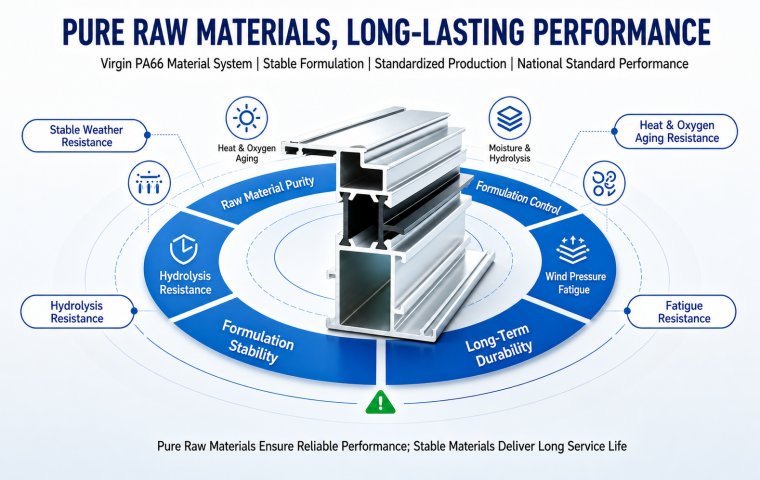
Only pure raw materials can guarantee product performance; only stable material properties can deliver long‑term service life. The standardization and purification of raw‑material sources constitute an essential pathway for the thermal‑insulation strip industry to phase out low‑cost‑low‑quality products and march toward high‑quality, long‑durability solutions.
Conclusion
Impure raw materials not only impair the basic physical properties of thermal‑insulation strips, but also completely destroy their long‑term performance including weather resistance, aging resistance, fatigue resistance and hydrolysis resistance, resulting in premature failure of doors and windows and frequent engineering hidden dangers. Only by sticking to the virgin PA66 material system, strictly controlling raw‑material purity and standardizing formula proportioning can high‑quality thermal‑insulation strips with stable performance, long service life and national‑standard compliance be manufactured, so as to safeguard the engineering quality of thermal‑break aluminum doors and windows.
I. Impure raw materials greatly accelerate the rates of thermal‑oxidative aging and ultraviolet aging
Pure virgin PA66 has a stable molecular structure and excellent resistance to thermal oxidation and ultraviolet radiation, aging slowly under long‑term exposure to sunlight and high‑temperature heat accumulation. In contrast, impure raw materials blended with recycled material, foreign material and inferior fillers contain a large number of chain‑broken molecules, active impurities and easily oxidized groups, which undergo rapid oxidative degradation under the action of high temperature, light and oxygen. Impurity particles become breakthrough points for aging, continuously inducing yellowing, chalking and surface peeling of the material.
Engineering data show that standard thermal‑insulation strips made of pure material can serve stably for more than 20 years without obvious aging; under outdoor exposure conditions, thermal‑insulation strips made of impure raw materials can obviously turn yellow and become brittle within 1 to 2 years, and suffer comprehensive aging failure within 3 to 5 years. Their service life is less than one‑third of that of genuine products, which is a typical case of premature short‑term failure.
II. Impurities and recycled materials cause overall deterioration of hydrolysis resistance and moisture resistance
The hydrolysis‑resistant and moisture‑proof performance of thermal‑insulation strips is critical under working‑condition environments such as plum‑rain seasons in southern China, coastal salt spray, exterior‑wall condensation and rain exposure. Pure PA66 features a dense material structure, low water‑absorption rate, slow hydrolysis speed and stable performance during dry‑wet cycles. Impure raw materials contain abundant internal micropores and impurities with large interfacial gaps, so moisture vapor can easily penetrate into the interior of the material, accelerating resin hydrolysis and glass‑fiber debonding.
In a long‑term high‑humidity environment, thermal‑insulation strips produced from impure raw materials will continuously absorb water, soften, delaminate, turn white and expand with deformation. The material gradually loses toughness, accompanied by expanding internal voids, loose structure and a sharp drop in mechanical properties. This eventually leads to cracking, fracture and insulation failure, making them completely unsuitable for humid and complex service conditions.
III. Chaotic raw‑material composition leads to total loss of temperature‑difference fatigue resistance
Thermal‑break aluminum doors and windows are constantly subjected to cyclic hot‑cold temperature fluctuations, which requires thermal‑insulation strips to deliver outstanding temperature fatigue resistance. Pure raw materials adopt a well‑balanced ratio of resin, glass fiber and additives, boasting a stable thermal expansion‑contraction coefficient to withstand long‑term cyclic deformation stress. Impure raw materials have complex components with vastly different thermal shrinkage coefficients among various constituents. As temperature varies, unsynchronized internal deformation generates persistent internal stress of separation, tension and slippage.
Every seasonal shift and day‑night temperature difference amplifies structural damage inside the material, causing progressive propagation of micro‑cracks and worsening delamination. Ultimately, structural defects such as distortion, end cracking and overall fracture of thermal‑insulation strips will occur, severely undermining the structural stability of composite thermal‑break aluminum profiles.
IV. Cascading Quality Hazards for Door‑and‑Window Projects Derived from Impure Raw Materials
First, permanent failure of building energy‑saving performance. Thermal‑insulation strips made from impure raw materials feature loose, porous interiors and unstable structures, failing to meet thermal‑conductivity requirements. With weak capacity to break thermal bridges, they cause excessive heat‑transfer coefficients of doors and windows and cannot pass energy‑saving acceptance. Problems such as indoor condensation and rising energy consumption persist year‑round.
Second, prominent structural safety risks for doors and windows. Thermal‑insulation strips with insufficient strength, lost toughness and premature aging cannot withstand wind pressure, self‑weight load and temperature‑difference stress. High‑rise buildings are highly vulnerable to profile deformation, sash loosening and corner joint cracking, creating long‑lasting safety hazards.
Third, high after‑sales rework costs and damaged brand reputation. Failures triggered by impure raw materials are delayed batch‑type defects, which are hard to detect in the early service stage but break out centrally several years later. Widespread faults including water leakage, deformation, cracking and aging bring difficult‑to‑handle and costly re‑repair work, and are very likely to cause construction disputes and decline in brand reputation.
V. Industry‑Upgrading Value of Strict Control over Raw‑Material Purity
Impure raw materials are the root cause of the vast majority of quality defects in the thermal‑insulation strip industry, covering nearly all common problems such as insufficient strength, poor toughness, unstable dimensions, easy deformation, cracking, rapid aging and excessive water absorption. To fundamentally rectify the chaotic quality situation of thermal‑insulation strips, strict access control over raw materials must be implemented at the source. Blending of recycled materials, substitution by inferior miscellaneous materials, excessive fillers and impurity contamination shall be eliminated, and standardized production with pure virgin materials shall be adhered to.
Only pure raw materials can guarantee product performance; only stable material properties can deliver long‑term service life. The standardization and purification of raw‑material sources constitute an essential pathway for the thermal‑insulation strip industry to phase out low‑cost‑low‑quality products and march toward high‑quality, long‑durability solutions.
Conclusion
Impure raw materials not only impair the basic physical properties of thermal‑insulation strips, but also completely destroy their long‑term performance including weather resistance, aging resistance, fatigue resistance and hydrolysis resistance, resulting in premature failure of doors and windows and frequent engineering hidden dangers. Only by sticking to the virgin PA66 material system, strictly controlling raw‑material purity and standardizing formula proportioning can high‑quality thermal‑insulation strips with stable performance, long service life and national‑standard compliance be manufactured, so as to safeguard the engineering quality of thermal‑break aluminum doors and windows.