
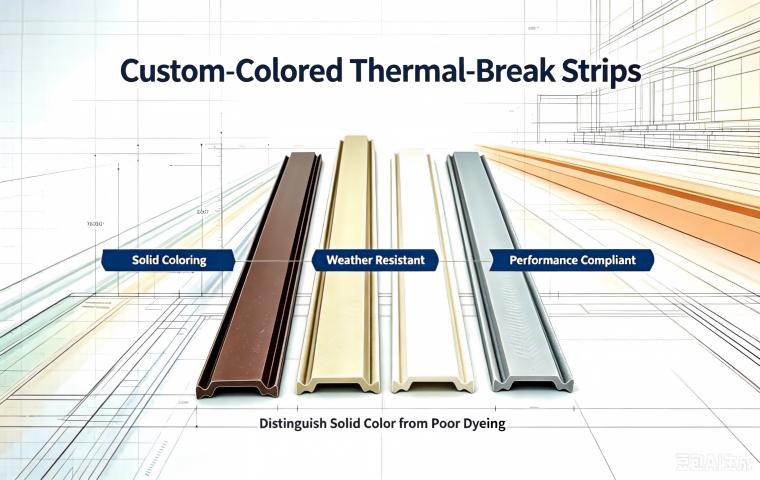
Market Value, Selection Misconceptions And Quality Control of Custom-colored Thermal Insulation Strips
With the upgrading of high-end and minimalist broken-bridge aluminum doors and windows, custom-colored thermal insulation strips have become key aesthetic and differentiated accessories, while widespread market irregularities have caused various performance defects. This paper summarizes the application value of colored thermal insulation strips, analyzes typical industry misconceptions, and identifies common counterfeiting behaviors including surface dyeing, recycled material concealment and unreasonable formula adjustment. It proposes intuitive and effective quality inspection methods and clarifies the positive industry significance of standardized color customization. The study aims to distinguish qualified integrally colored products from inferior counterfeits, guide standardized production and selection, and balance the aesthetic upgrade and structural safety of door and window thermal insulation strips.
As the broken-bridge aluminum door and window industry upgrades toward high-end, minimalist and integrated development, the overall visual consistency and advanced color matching of complete windows have become important indicators of product quality. Traditional single black thermal insulation strips easily cause black penetration, exposed edges and abrupt visual effects on narrow-edge minimalist windows, white windows, light-colored profiles and large glass partitions, undermining the overall aesthetic of windows. The popularization of customized color technology for thermal insulation strips completely solves the industry pain point of inconsistent window color matching. However, the current market is plagued by irregularities in colored thermal insulation strips. Many manufacturers cover material defects, replace formulas and reduce material standards through color customization, resulting in common problems such as easy aging, brittle cracking and substandard performance of colored strips. This paper deeply analyzes the application value, market misconceptions and refined selection and control schemes of customized colored thermal insulation strips.
I. Core Application Value of Custom-Colored Thermal Insulation Strips
First, it realizes the visual integration of the whole window and upgrades the product appearance grade. For narrow-edge minimalist doors and windows, popular cream-style windows, and white sprayed profiles, the application of traditional black thermal insulation strips leads to obvious black penetration in cavity gaps, disordered layering and a cheap visual effect. Customizing thermal insulation strips with the same or similar colors as the profiles conceals cavity gaps and achieves unified coloring, presenting a minimalist and high-end overall window look and greatly improving the aesthetics and premium value of finished products.
Second, it adapts to high-end engineering customization needs and realizes brand differentiation. Leading door and window brands, fine decoration real estate projects and high-end villa projects generally adopt exclusive color systems. Custom brand-specific thermal insulation strips enable product differentiation from low-end generic products, enhancing brand recognition and project delivery quality.
Third, it maintains structural performance and balances aesthetics and safety. Formal integrally colored custom thermal insulation strips strictly follow national standard formulas and production processes, with thermal insulation, aging resistance, cracking resistance and deformation resistance fully consistent with conventional black thermal insulation strips. While optimizing the appearance, they ensure the structural safety and qualified energy-saving indicators of doors and windows, achieving a perfect balance between excellent appearance and reliable performance.
II. Common Market Chaos and Selection Misconceptions of Colored Thermal Insulation Strips
Misconception 1: Colored thermal insulation strips are inferior in performance to black ones.Formal integrally colored products maintain exactly the same performance and have no quality difference compared with black strips. Color is merely a visual attribute. The poor performance of inferior colored strips on the market stems from reduced raw material specifications and fraudulent production processes, rather than the color itself.
Misconception 2: Surface dyeing and spraying counterfeit integral color customization.Low-cost products cover the base color of inferior materials through post-spraying and surface dyeing. Although the surface color looks uniform, the interior is made of recycled miscellaneous materials with obvious white cores after cutting. Such products frequently suffer from color fading, embrittlement and cracking in later service, belonging to typical non-standard and shoddy products.
Misconception 3: Dark colors are used to cover yellowing and black defects of recycled materials.Thermal insulation strips made from massive recycled materials feature dull and mottled inherent colors. Manufacturers cover material defects by adopting deep black or dark gray tones and disguise them as customized products. These strips are highly brittle with numerous impurities, and the internal glass fibers turn black after calcination, carrying severe quality risks.
Misconception 4: Formula proportion is sacrificed for color adjustment.To achieve special light or bright color effects, some manufacturers greatly increase pigments and fillers while reducing the proportion of glass fibers and resin. This leads to decreased strength, insufficient toughness, frequent cracking and deformation, and seriously substandard overall performance of thermal insulation strips.
III. Quality Identification and Acceptance Methods for Custom-Colored Thermal Insulation Strips
First, cross-section inspection. High-quality custom-colored thermal insulation strips feature a uniform integral cross-section without color difference, white cores or mixed layers. Inferior dyed products show white centers and color delamination on the cross-section, which can be identified at a glance.
Second, weather resistance inspection. Qualified weather-resistant color masterbatch ensures no fading under long-term sunlight exposure. Simple tests including high-temperature baking and ultraviolet irradiation can be adopted to check for yellowing, decolorization and discoloration, so as to quickly screen inferior products.
Third, calcination identification. After calcination, qualified colored thermal insulation strips present pure white glass fibers without blackening, yellowing or impurity agglomeration. In contrast, inferior colored strips have dull and blackened glass fibers after calcination due to impure raw materials and excessive fillers, with obvious defective characteristics.
Fourth, performance benchmark inspection. Custom-colored thermal insulation strips must comply with the same national testing standards as standard black strips, with consistent indicators in tensile property, impact resistance and thermal aging resistance. Performance standards shall never be reduced for color customization.
IV. Industry Significance of Standardized Application of Colored Thermal Insulation Strips
The standardized popularization of color customization technology breaks the inherent limitation of single-color thermal insulation strips in the industry, adapts to the aesthetic upgrading trend of modern doors and windows, and promotes the upgrading of broken-bridge aluminum doors and windows from functional products to high-end customized products with superior appearance. Meanwhile, standardized quality control for colored thermal insulation strips effectively curbs market irregularities such as counterfeiting through surface dyeing and covering material defects with color adjustment, corrects industry cognitive deviations, and guides the market to evaluate products based on material quality and performance rather than color appearance.
For door and window enterprises, the rational application of custom-colored thermal insulation strips not only improves product appearance and market competitiveness, but also ensures stable engineering quality, serving as an important quality improvement method for the high-end development of the current door and window industry.
Conclusion
Color customization of thermal insulation strips is a harmless, compliant, and mature appearance upgrading process with no inherent quality defects. All market irregularities stem from counterfeiting and material reduction practices adopted by unqualified manufacturers. Custom integrally colored thermal insulation strips with unchanged performance and stable weather resistance can perfectly match various high-end doors, windows and customized engineering projects. The industry shall establish correct cognition to distinguish standardized customization processes from inferior dyed counterfeits, strictly control raw materials and performance indicators of colored thermal insulation strips, and achieve dual guarantees for the aesthetic effect and structural quality of door and window products.
I. Core Application Value of Custom-Colored Thermal Insulation Strips
First, it realizes the visual integration of the whole window and upgrades the product appearance grade. For narrow-edge minimalist doors and windows, popular cream-style windows, and white sprayed profiles, the application of traditional black thermal insulation strips leads to obvious black penetration in cavity gaps, disordered layering and a cheap visual effect. Customizing thermal insulation strips with the same or similar colors as the profiles conceals cavity gaps and achieves unified coloring, presenting a minimalist and high-end overall window look and greatly improving the aesthetics and premium value of finished products.
Second, it adapts to high-end engineering customization needs and realizes brand differentiation. Leading door and window brands, fine decoration real estate projects and high-end villa projects generally adopt exclusive color systems. Custom brand-specific thermal insulation strips enable product differentiation from low-end generic products, enhancing brand recognition and project delivery quality.
Third, it maintains structural performance and balances aesthetics and safety. Formal integrally colored custom thermal insulation strips strictly follow national standard formulas and production processes, with thermal insulation, aging resistance, cracking resistance and deformation resistance fully consistent with conventional black thermal insulation strips. While optimizing the appearance, they ensure the structural safety and qualified energy-saving indicators of doors and windows, achieving a perfect balance between excellent appearance and reliable performance.
II. Common Market Chaos and Selection Misconceptions of Colored Thermal Insulation Strips
Misconception 1: Colored thermal insulation strips are inferior in performance to black ones.Formal integrally colored products maintain exactly the same performance and have no quality difference compared with black strips. Color is merely a visual attribute. The poor performance of inferior colored strips on the market stems from reduced raw material specifications and fraudulent production processes, rather than the color itself.
Misconception 2: Surface dyeing and spraying counterfeit integral color customization.Low-cost products cover the base color of inferior materials through post-spraying and surface dyeing. Although the surface color looks uniform, the interior is made of recycled miscellaneous materials with obvious white cores after cutting. Such products frequently suffer from color fading, embrittlement and cracking in later service, belonging to typical non-standard and shoddy products.
Misconception 3: Dark colors are used to cover yellowing and black defects of recycled materials.Thermal insulation strips made from massive recycled materials feature dull and mottled inherent colors. Manufacturers cover material defects by adopting deep black or dark gray tones and disguise them as customized products. These strips are highly brittle with numerous impurities, and the internal glass fibers turn black after calcination, carrying severe quality risks.
Misconception 4: Formula proportion is sacrificed for color adjustment.To achieve special light or bright color effects, some manufacturers greatly increase pigments and fillers while reducing the proportion of glass fibers and resin. This leads to decreased strength, insufficient toughness, frequent cracking and deformation, and seriously substandard overall performance of thermal insulation strips.
III. Quality Identification and Acceptance Methods for Custom-Colored Thermal Insulation Strips
First, cross-section inspection. High-quality custom-colored thermal insulation strips feature a uniform integral cross-section without color difference, white cores or mixed layers. Inferior dyed products show white centers and color delamination on the cross-section, which can be identified at a glance.
Second, weather resistance inspection. Qualified weather-resistant color masterbatch ensures no fading under long-term sunlight exposure. Simple tests including high-temperature baking and ultraviolet irradiation can be adopted to check for yellowing, decolorization and discoloration, so as to quickly screen inferior products.
Third, calcination identification. After calcination, qualified colored thermal insulation strips present pure white glass fibers without blackening, yellowing or impurity agglomeration. In contrast, inferior colored strips have dull and blackened glass fibers after calcination due to impure raw materials and excessive fillers, with obvious defective characteristics.
Fourth, performance benchmark inspection. Custom-colored thermal insulation strips must comply with the same national testing standards as standard black strips, with consistent indicators in tensile property, impact resistance and thermal aging resistance. Performance standards shall never be reduced for color customization.
IV. Industry Significance of Standardized Application of Colored Thermal Insulation Strips
The standardized popularization of color customization technology breaks the inherent limitation of single-color thermal insulation strips in the industry, adapts to the aesthetic upgrading trend of modern doors and windows, and promotes the upgrading of broken-bridge aluminum doors and windows from functional products to high-end customized products with superior appearance. Meanwhile, standardized quality control for colored thermal insulation strips effectively curbs market irregularities such as counterfeiting through surface dyeing and covering material defects with color adjustment, corrects industry cognitive deviations, and guides the market to evaluate products based on material quality and performance rather than color appearance.
For door and window enterprises, the rational application of custom-colored thermal insulation strips not only improves product appearance and market competitiveness, but also ensures stable engineering quality, serving as an important quality improvement method for the high-end development of the current door and window industry.
Conclusion
Color customization of thermal insulation strips is a harmless, compliant, and mature appearance upgrading process with no inherent quality defects. All market irregularities stem from counterfeiting and material reduction practices adopted by unqualified manufacturers. Custom integrally colored thermal insulation strips with unchanged performance and stable weather resistance can perfectly match various high-end doors, windows and customized engineering projects. The industry shall establish correct cognition to distinguish standardized customization processes from inferior dyed counterfeits, strictly control raw materials and performance indicators of colored thermal insulation strips, and achieve dual guarantees for the aesthetic effect and structural quality of door and window products.