
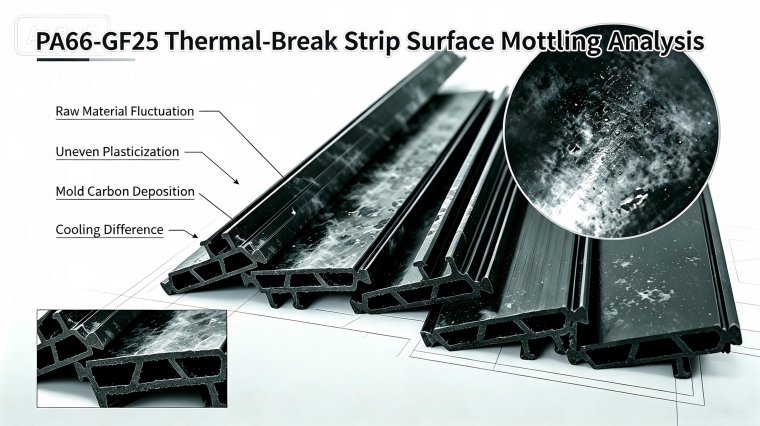
Analysis of Internal Causes for Mottled Surface of Thermal‑Break Strips During Extrusion Production
Ⅰ. Mottling Defects Caused by Unstable Raw‑Material Components
The substrate of PA66 thermal‑break strips consists of PA66 nylon resin filled with 25% glass fiber. The homogeneity of the raw‑material system forms the foundation for consistent surface appearance. Fluctuations between raw‑material batches, uneven mixing of new and recycled materials, uncontrolled proportion of regrind, or poor compatibility between different masterbatches and additives will lead to inconsistent melting rates of each component inside the melt. During screw plasticization, partial nylon resin fails to melt completely and glass fibers are poorly dispersed, forming local component‑rich zones in the melt. Once extruded onto the profile surface, these zones produce mottled patches with varying gloss.
Besides, inadequate drying of moisture‑laden raw materials is another common trigger. PA66 is highly hygroscopic. If the drying temperature or duration is insufficient, residual moisture inside pellets vaporizes under high extrusion temperature and generates tiny bubbles within the melt. When bubbles rupture at the die exit, matte, uneven and mottled marks are left on the surface of thermal‑break strips. This type of mottling usually appears in patches without fixed stripe orientation.
Ⅱ. Surface Mottling Induced by Unbalanced Extrusion and Plasticization Parameters
Improper temperature settings across each barrel zone of the extruder directly result in non‑uniform melt plasticization. Low local barrel temperature causes incomplete plasticization of nylon melt, while excessive temperature triggers partial thermal degradation and slight carbonization of nylon. Both conditions destabilize melt flow and produce alternating light‑and‑dark mottled marks on the profile surface after extrusion from the die cavity.
Mismatch between screw speed and haul‑off speed leads to severe melt‑pressure fluctuation, unstable output flow from the die head and periodic variation of melt shear rate. Affected by shear force, glass fibers inside the melt show inconsistent local orientation. Different exposure levels of glass fibers at various profile positions create varied surface reflection effects, which are visible to the naked eye as mottled patches. Mottling caused by such process defects is often distributed in strips or bands along the extrusion direction.
Ⅲ. Surface Mottling Triggered by Mould and Cooling‑Sizing System
Worn flow‑channel surfaces, carbon deposits, residues or scratches on the inner wall of extrusion moulds cause partial melt stagnation and local thermal decomposition when the melt flows through. The stagnated and degraded material is intermittently carried out of the die orifice and adheres to the thermal‑break‑strip surface, forming irregular dark mottled patches. Uneven die‑exit temperature distribution or partial failure of die‑heating rings leads to inconsistent melt‑outlet temperature across the profile cross‑section and varied cooling rates, eventually producing light‑and‑dark mottling due to uneven surface gloss after cooling.
During cooling and sizing, uneven cooling‑water temperature, excessive water impact in the cooling tank and inconsistent thickness of the water film on the profile surface cause different cooling‑shrinkage rates at each point of the thermal‑break‑strip cross‑section. The surface‑layer molecules crystallize at different speeds, resulting in regional differences in nylon crystallinity. Areas with high and low crystallinity reflect light differently, presenting large‑area fog‑like mottling on the finished surface. This defect originates from the post‑extrusion sizing stage and generally exerts no obvious impact on the internal mechanical properties of thermal‑break strips; it is merely an appearance‑related defect.
Ⅳ. Preliminary Identification Guidelines for Production‑Generated Mottling Defects
Mottling formed during production can be visually detected immediately after extrusion and cooling. Defect locations are fixed and extend continuously along the extrusion length. During quality inspection, cross‑section cutting can be adopted to check for internal defects such as bubbles, delamination and glass‑fiber agglomeration beneath mottled zones. Uniform internal material without abnormalities indicates that the mottling is only a cosmetic flaw. Products accompanied by internal material defects shall be rejected due to potential risks to mechanical performance.
Conclusion
Surface mottling of thermal‑break strips during extrusion mainly stems from four factors: raw‑material stability, plasticization processes, mould conditions and cooling‑sizing performance. Controlling raw‑material quality, implementing strict drying procedures, stabilizing extrusion parameters and carrying out regular mould cleaning and maintenance are the primary technical measures to reduce the occurrence rate of surface mottling defects at the production source.