
Influence Mechanism and Process Control of Shrinkage for PA66GF25 Thermal Barrier Strips
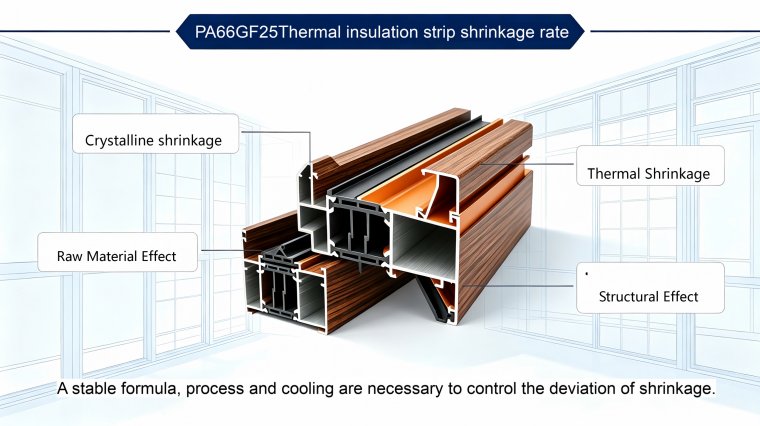
Shrinkage stability depends on raw material formulation. 25% glass fiber suppresses shrinkage, whereas recycled materials, poor fiber dispersion and excess fillers induce uneven shrinkage and residual stress. Improper extrusion, cooling and uneven cross-sections cause deformation.
Slight aging shrinkage appears 7–15 days post-production, creating assembly risks. Shrinkage results from materials, formula, extrusion and cooling. Stable raw materials and processes control shrinkage and secure dimensional accuracy.
PA66GF25 thermal barrier strips are extruded profiles made of glass fiber reinforced polyamide. The material exhibits inherent thermal shrinkage and crystallization shrinkage characteristics typical of polymer materials. The shrinkage rate of thermal barrier strips refers to the linear proportional dimensional and volumetric contraction of the product after high-temperature melt extrusion, cooling and shaping until it reaches a steady state at ambient temperature. It serves as a core technical indicator for evaluating dimensional stability, molding consistency and structural compactness of the product.
In accordance with GB/T 23615.1-2017, finished thermal barrier strips shall maintain stable dimensions, and deviations from cooling shrinkage and aging shrinkage must stay within tolerance control limits; otherwise, batch dimensional inaccuracy will occur. Shrinkage of thermal barrier strips falls into two categories: instantaneous shrinkage during extrusion cooling and slow aging shrinkage at room temperature. The magnitude of shrinkage rate is jointly determined by material composition, extrusion process, cooling gradient and cross-sectional structure. This paper systematically analyzes the formation principle and influencing rules of the shrinkage rate of thermal barrier strips from the perspectives of material mechanism and production technology.
I. Basic Physical and Material Mechanism of Thermal Barrier Strip Shrinkage
PA66 nylon resin is a semi-crystalline polymer material. At high melting temperatures, molecular chains are in a disordered and stretched state, leading to material volume expansion and increased intermolecular spacing. During extrusion cooling, the melt temperature gradually drops, the mobility of polymer chains weakens, molecular structures rearrange and crystallize to become denser. Macroscopically, this manifests as dimensional and volumetric contraction, namely crystallization shrinkage. Meanwhile, high-temperature extruded profiles undergo physical thermal contraction caused by thermal expansion and contraction during natural cooling. The superposition of these two types of shrinkage constitutes the overall shrinkage rate of thermal barrier strips.
As a rigid inorganic filler, glass fiber features extremely low shrinkage rate and stable dimensions. It functions to restrain shrinkage and fix dimensions within the material system. One primary purpose of the national standard 25% glass fiber formulation is to greatly reduce the high shrinkage property of neat nylon, enabling the shrinkage rate of thermal barrier strips to be stable and controllable. Qualified PA66GF25 thermal barrier strips deliver uniform and slight shrinkage. In contrast, products with insufficient glass fiber content, mixed fillers or blended recycled materials have a higher resin proportion, resulting in substantially elevated and uneven overall shrinkage and complete loss of dimensional stability.
II. Decisive Influence of Raw Material Composition on Shrinkage Rate
Raw material purity and formulation system form the fundamental conditions determining shrinkage rate. Virgin PA66 resin presents stable crystallization behavior with fixed, linearly uniform shrinkage values. Raw materials mixed with recycled materials suffer molecular chain length variation and disturbed crystallization rates from repeated high-temperature degradation, leading to erratic fluctuation of shrinkage rates and obvious shrinkage differences within the same batch of products.
Glass fiber content directly restricts shrinkage magnitude: the lower the glass fiber proportion, the higher the resin proportion and the more prominent the overall shrinkage. Uneven glass fiber dispersion and local agglomeration cause inconsistent cross-section shrinkage of profiles, triggering problems such as one-sided shrinkage, local depressions and twisting deformation. Furthermore, excessive inorganic fillers like calcium carbonate and talcum powder disrupt crystallization uniformity, creating different shrinkage rates between the surface and interior of profiles. The surface cools rapidly and shrinks more while the interior cools slowly with delayed shrinkage, inducing internal residual stress and potential deformation risks.
III. Influence Rules of Extrusion Process Parameters on Shrinkage Fluctuation
Extrusion temperature, screw speed and haul-off speed are core process parameters for shrinkage rate regulation. Overhigh temperatures in each barrel zone enable sufficient melt plasticization and full molecular stretching, resulting in relatively larger crystallization shrinkage after cooling. Insufficient temperature leads to inadequate plasticization and low crystallinity, with small and unstable shrinkage. Temperature fluctuations directly produce shrinkage differences between batches and degrade product dimensional consistency.
Haul-off speed and cooling rate determine the shrinkage state during shaping. Excessively fast haul-off forcibly stretches profiles before full cooling and shaping, orienting stretched molecular chains that continuously retract during subsequent room-temperature aging and produce secondary shrinkage. Excessively high cooling water temperature or an overly short cooling tank creates insufficient internal-external cooling gradients for profiles. The surface sets quickly while the interior shrinks slowly, causing latent post-production shrinkage, bending and twisting. A stable gradient cooling process is critical to control instantaneous shrinkage and aging shrinkage.
IV. Shrinkage Deviations Induced by Cross-Section Structure and Wall Thickness Differences
Thermal barrier strips of different structural models exhibit structural differences in shrinkage rate due to variations in cross-section wall thickness, cavity layout and rib distribution. Symmetric thermal barrier strips with uniform wall thickness achieve synchronized cooling, even shrinkage and stable deformation. Structures with uneven wall thickness, abrupt cross-section changes, sharp corners and thin edges feature slow cooling and large shrinkage in thick-wall regions, and fast cooling and small shrinkage in thin-wall regions. Unsynchronized shrinkage across cross-section points readily causes twisting, lateral bending and warpage deformation.
Multi-cavity structures, divided by internal ribs, offer large cooling area and uniform heat dissipation, leading to lower overall shrinkage rate and better consistency. Single-cavity large hollow structures have slow heat dissipation at the center with stronger shrinkage lag and more obvious later-stage aging shrinkage. Therefore, structural complexity directly governs shrinkage stability, which is also the key reason for reserving shrinkage compensation during custom mold opening.
V. Characteristics and Technical Rules of Aging Delayed Shrinkage
Shrinkage of thermal barrier strips does not only occur in the production cooling phase. Minor aging shrinkage still takes place within 7 to 15 days after finished products leave the factory. Profiles with incompletely released internal stress undergo continuous molecular rearrangement and slow stress release at ambient temperature, generating slight dimensional retraction. Products manufactured under unstable processes, rapid cooling or over-stretching have larger aging shrinkage, which may lead to hidden defects: qualified dimensions upon delivery, reduced dimensions afterwards and enlarged assembly gaps. Stable production processes and adequate aging treatment can minimize dimensional deviations caused by delayed shrinkage.
Conclusion
The shrinkage rate of thermal barrier strips results from the combined effects of material properties, formulation structure, extrusion process and cooling shaping. Uncontrolled shrinkage essentially arises from the combined effects of disordered crystallization, residual stress, uneven cooling and non-standard formulations. Mastering the shrinkage formation mechanism and stabilizing raw materials and process parameters can control shrinkage deviations from the source and guarantee dimensional accuracy and structural stability of thermal barrier strips.