
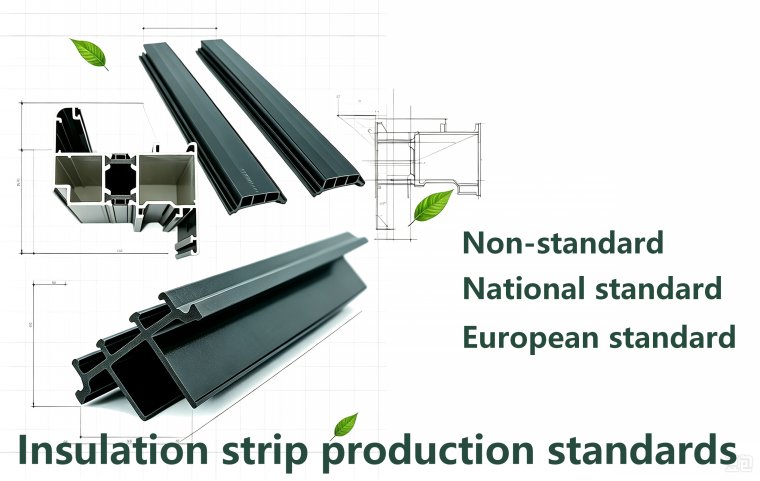
Analysis of Differences in Material Systems And Basic Technical Parameters of Non-standard, National Standard And European Standard Thermal Break Strips
Non-standard insulation strips have poor quality, lack standardization and performance, and do not comply with regulations. National standard insulation strips have pure materials and meet the parameters, which are suitable for domestic conventional projects. European standard base materials are the same as national standards, but the standards for durability, precision, and stability are higher, and they are suitable for high-end doors and windows. The three are the hierarchical differences of a complete technical system and are important criteria for material selection in engineering.
Thermal break strips for broken‑bridge aluminum profiles can be classified into three grades according to applicable production standards: non‑standard, Chinese national standard, and European standard. Clear technical gaps exist among them in substrate composition, glass‑fiber proportion, mechanical thresholds, weather resistance indicators and dimensional tolerance systems.
In accordance with China’s current national standard GB/T 23615.1‑2017 and EU industry standard EN 14024, quantitative mandatory requirements are specified for material purity, physical properties and test items of thermal break strips. By contrast, non‑standard products follow no unified specifications and their parameters are not subject to standard constraints. This article objectively analyzes the fundamental technical differences of the three types of thermal break strips from four dimensions: material mechanism, core technical parameters, test benchmarks and forming accuracy. It is a purely technical and compliance‑oriented analysis without sales‑oriented highlights.
I. Non‑Standard Thermal Break Strips: No Standardized Material System or Parameter Constraints
Non‑standard thermal break strips generally refer to insulating strips not manufactured in compliance with Chinese national or European standards. They have no fixed material formula, no mandatory performance indicators and no unified test standards, and are low‑grade non‑standard products in the industry.
In terms of materials, non‑standard thermal break strips commonly suffer from mixed base materials. Impure PA6 mixtures, recycled nylon, modified PVC materials and fillers are widely used to replace pure PA66 resin. Some products drastically cut glass‑fiber content, or add excessive inorganic fillers such as calcium carbonate and talcum powder to lower production costs.
Unregulated components directly lead to unstable basic parameters and large batch‑to‑batch dispersion. Such products have no fixed values for tensile strength, melting temperature or heat‑deflection temperature. Their DSC melting peak temperature is usually below 255 °C and fails to meet the basic identification criteria for polyamide materials.
For mechanical performance, non‑standard thermal break strips normally show tensile strength lower than 70 MPa. Certain brittle modified products fracture easily under stress, with unreliable toughness, creep resistance and fatigue resistance. Dimensional tolerances, flatness and symmetry are uncontrolled. Forming accuracy depends entirely on equipment conditions with no grade classification.
From a compliance perspective, non‑standard thermal break strips fail to satisfy energy‑saving acceptance requirements and structural‑safety codes for building doors and windows, and are non‑compliant materials for engineering projects.
II. National‑Standard Thermal Break Strips: Unified Domestic Material and Quantified Technical Benchmarks
National‑standard thermal break strips are manufactured in strict accordance with GB/T 23615.1‑2017, the Chinese national standard, and are compliant products commonly used for domestic building doors and windows.
The standard explicitly stipulates that virgin PA66 resin must be adopted as the base material. Mixing of recycled materials, miscellaneous scrap materials or alternative plastics is prohibited. The glass‑fiber content is fixed at 25%±2.5% to balance the rigidity and toughness of the material.
The national‑standard system establishes complete quantified thresholds: the characteristic value of longitudinal tensile strength at room temperature ≥90 MPa; DSC melting‑peak temperature ≥255 °C; the minimum local wall thickness for Type‑I profiles shall not be less than 0.72 mm. Clear minimum requirement values are also specified for heat‑deflection temperature, water absorption and aging performance.
In terms of precision system, the national standard divides thermal break strips into two tolerance grades: ordinary grade and high‑precision grade, each with fixed dimensional fluctuation ranges to ensure batch consistency of products.
Featuring stable material structure, controllable parameters and traceable testing, national‑standard thermal break strips can meet the structural safety and energy‑saving requirements of most domestic residential buildings, commercial buildings and conventional curtain‑wall projects. The core characteristics of the national‑standard system are standardized parameters, standardized testing and fixed minimum performance requirements, which serve as the basic compliance basis for domestic project acceptance.
III. European‑Standard Thermal Break Strips: Advanced Technical Benchmark System of EU EN 14024
European‑standard thermal break strips comply with EU building thermal‑barrier profile standard EN 14024. Based on pure PA66GF25 base material, they impose stricter performance margin and durability test items.
Their material composition is consistent with the Chinese national standard, which also specifies virgin PA66 plus 25% alkali‑free glass fiber and prohibits miscellaneous and recycled materials. Nevertheless, they feature higher thresholds for long‑term indicators including mechanical stability, long‑term creep, high‑temperature durability, low‑temperature impact and humidity‑heat cycling.
The core upgrade of the European‑standard system lies in steady‑state performance control, with emphasis on deformation stability and performance retention rate under long‑term load. The standard requires higher retention of mechanical properties, lower creep deformation and more stable low‑temperature impact resistance after long‑term thermo‑oxidative aging, humidity‑heat cycling and fatigue loading.
Dimensional precision control is more stringent with narrower error ranges for batch dimensional consistency, cross‑section symmetry and flatness, matching the high‑precision assembly system of European system windows and doors. Its overall technical logic focuses on long‑term durability, adaptability to complex working conditions and long‑term dimensional stability.
IV. Summary of Basic‑attribute Differences Among Three Types of Thermal Break Strips
Non‑standard thermal break strips have no standardized system. With mixed materials, fluctuating parameters and no guaranteed minimum performance, they only realize basic visual assembly and provide no structural‑safety or energy‑saving assurance.
National‑standard thermal break strips set the domestic compliance baseline with quantified parameters, standardized tests and stable performance, suitable for conventional construction projects.
On the basis of compliance, European‑standard thermal break strips improve durability margin and precision grade, and apply to high‑standard, long‑life system doors, windows and curtain‑wall projects under complex working conditions.
Essentially, the technical gaps among them represent hierarchical differences in material control precision, performance thresholds, durability criteria and test strictness.
Conclusion
The differences among non‑standard, national‑standard and European‑standard thermal break strips are not simple grade distinctions, but systematic gaps in material systems, technical parameters, test standards and performance redundancy. Clarifying the basic technical specifications of the three types of products is a prerequisite for compliant material selection in engineering, qualified door‑and‑window performance and stable long‑term service.
In accordance with China’s current national standard GB/T 23615.1‑2017 and EU industry standard EN 14024, quantitative mandatory requirements are specified for material purity, physical properties and test items of thermal break strips. By contrast, non‑standard products follow no unified specifications and their parameters are not subject to standard constraints. This article objectively analyzes the fundamental technical differences of the three types of thermal break strips from four dimensions: material mechanism, core technical parameters, test benchmarks and forming accuracy. It is a purely technical and compliance‑oriented analysis without sales‑oriented highlights.
I. Non‑Standard Thermal Break Strips: No Standardized Material System or Parameter Constraints
Non‑standard thermal break strips generally refer to insulating strips not manufactured in compliance with Chinese national or European standards. They have no fixed material formula, no mandatory performance indicators and no unified test standards, and are low‑grade non‑standard products in the industry.
In terms of materials, non‑standard thermal break strips commonly suffer from mixed base materials. Impure PA6 mixtures, recycled nylon, modified PVC materials and fillers are widely used to replace pure PA66 resin. Some products drastically cut glass‑fiber content, or add excessive inorganic fillers such as calcium carbonate and talcum powder to lower production costs.
Unregulated components directly lead to unstable basic parameters and large batch‑to‑batch dispersion. Such products have no fixed values for tensile strength, melting temperature or heat‑deflection temperature. Their DSC melting peak temperature is usually below 255 °C and fails to meet the basic identification criteria for polyamide materials.
For mechanical performance, non‑standard thermal break strips normally show tensile strength lower than 70 MPa. Certain brittle modified products fracture easily under stress, with unreliable toughness, creep resistance and fatigue resistance. Dimensional tolerances, flatness and symmetry are uncontrolled. Forming accuracy depends entirely on equipment conditions with no grade classification.
From a compliance perspective, non‑standard thermal break strips fail to satisfy energy‑saving acceptance requirements and structural‑safety codes for building doors and windows, and are non‑compliant materials for engineering projects.
II. National‑Standard Thermal Break Strips: Unified Domestic Material and Quantified Technical Benchmarks
National‑standard thermal break strips are manufactured in strict accordance with GB/T 23615.1‑2017, the Chinese national standard, and are compliant products commonly used for domestic building doors and windows.
The standard explicitly stipulates that virgin PA66 resin must be adopted as the base material. Mixing of recycled materials, miscellaneous scrap materials or alternative plastics is prohibited. The glass‑fiber content is fixed at 25%±2.5% to balance the rigidity and toughness of the material.
The national‑standard system establishes complete quantified thresholds: the characteristic value of longitudinal tensile strength at room temperature ≥90 MPa; DSC melting‑peak temperature ≥255 °C; the minimum local wall thickness for Type‑I profiles shall not be less than 0.72 mm. Clear minimum requirement values are also specified for heat‑deflection temperature, water absorption and aging performance.
In terms of precision system, the national standard divides thermal break strips into two tolerance grades: ordinary grade and high‑precision grade, each with fixed dimensional fluctuation ranges to ensure batch consistency of products.
Featuring stable material structure, controllable parameters and traceable testing, national‑standard thermal break strips can meet the structural safety and energy‑saving requirements of most domestic residential buildings, commercial buildings and conventional curtain‑wall projects. The core characteristics of the national‑standard system are standardized parameters, standardized testing and fixed minimum performance requirements, which serve as the basic compliance basis for domestic project acceptance.
III. European‑Standard Thermal Break Strips: Advanced Technical Benchmark System of EU EN 14024
European‑standard thermal break strips comply with EU building thermal‑barrier profile standard EN 14024. Based on pure PA66GF25 base material, they impose stricter performance margin and durability test items.
Their material composition is consistent with the Chinese national standard, which also specifies virgin PA66 plus 25% alkali‑free glass fiber and prohibits miscellaneous and recycled materials. Nevertheless, they feature higher thresholds for long‑term indicators including mechanical stability, long‑term creep, high‑temperature durability, low‑temperature impact and humidity‑heat cycling.
The core upgrade of the European‑standard system lies in steady‑state performance control, with emphasis on deformation stability and performance retention rate under long‑term load. The standard requires higher retention of mechanical properties, lower creep deformation and more stable low‑temperature impact resistance after long‑term thermo‑oxidative aging, humidity‑heat cycling and fatigue loading.
Dimensional precision control is more stringent with narrower error ranges for batch dimensional consistency, cross‑section symmetry and flatness, matching the high‑precision assembly system of European system windows and doors. Its overall technical logic focuses on long‑term durability, adaptability to complex working conditions and long‑term dimensional stability.
IV. Summary of Basic‑attribute Differences Among Three Types of Thermal Break Strips
Non‑standard thermal break strips have no standardized system. With mixed materials, fluctuating parameters and no guaranteed minimum performance, they only realize basic visual assembly and provide no structural‑safety or energy‑saving assurance.
National‑standard thermal break strips set the domestic compliance baseline with quantified parameters, standardized tests and stable performance, suitable for conventional construction projects.
On the basis of compliance, European‑standard thermal break strips improve durability margin and precision grade, and apply to high‑standard, long‑life system doors, windows and curtain‑wall projects under complex working conditions.
Essentially, the technical gaps among them represent hierarchical differences in material control precision, performance thresholds, durability criteria and test strictness.
Conclusion
The differences among non‑standard, national‑standard and European‑standard thermal break strips are not simple grade distinctions, but systematic gaps in material systems, technical parameters, test standards and performance redundancy. Clarifying the basic technical specifications of the three types of products is a prerequisite for compliant material selection in engineering, qualified door‑and‑window performance and stable long‑term service.