
Analysis of The Material Properties And Structural Causes of The Bending Deformation of The Insulation Strips
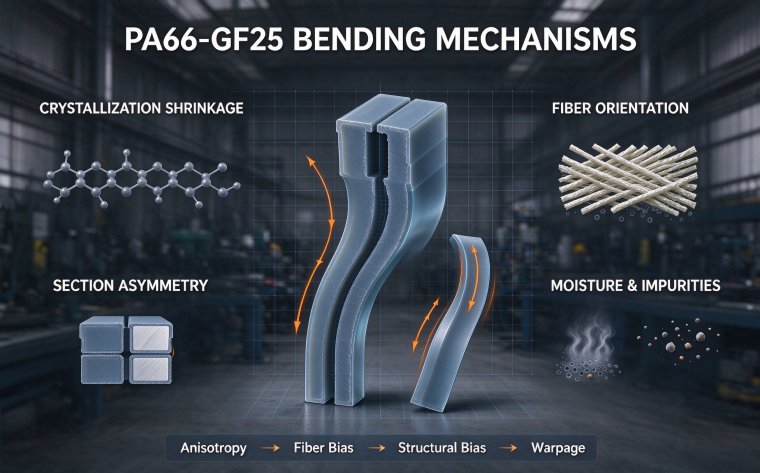
Bending, warpage and torsion of PA66GF25 thermal break strips are mainly caused by the material’s inherent anisotropic shrinkage, uneven glass fiber orientation and asymmetric cross-sectional structures, rather than equipment faults. Raw material moisture and component disorders further aggravate deformation. These structural defects are unavoidable and can only be improved via precise die compensation and refined process control.
Defects such as side bending, warpage, twist and arc bending occurring during the forming production of PA66GF25 thermal break strips mostly stem from the inherent physical properties of materials and the innate characteristics of cross-sectional structures, rather than simple equipment adjustment issues. As a semi-crystalline polymer, PA66 exhibits obvious anisotropic shrinkage when reinforced with glass fiber, which serves as the core root cause of bending that distinguishes thermal break strips from ordinary plastic profiles. This article provides a purely technical analysis of the underlying mechanism of forming bending in thermal break strips from three innate dimensions: material crystallization rules, glass fiber orientation characteristics and cross-sectional structural differences, clarifying the unavoidable nature and technical laws of structural bending.
The shrinkage difference of neat PA66 is relatively manageable. However, after blending with 25% glass fiber for reinforcement, material anisotropy is further amplified. Glass fibers themselves barely shrink and restrict shrinkage along the melt flow direction, while regions perpendicular to the flow lack effective restraint, widening the shrinkage gap. Even with fully standardized equipment and processes, qualified PA66GF25 thermal break strips inherently carry a slight bending tendency as an intrinsic physical property of the material. This tendency can only be offset via process optimization and cannot be completely eliminated.
II. Unbalanced unilateral stress caused by uneven dispersion and orientation of glass fibers
During extrusion of thermal break strips, glass fibers align along the melt flow direction. Under normal homogeneous extrusion, glass fibers are evenly distributed and consistently oriented across all cross-sectional zones; shrinkage stresses counterbalance one another, keeping profiles straight. In contrast, insufficient plasticization of raw materials or fluctuations in melt fluidity lead to local glass fiber agglomeration, dense glass fiber on one side and disordered regional orientation.
Zones with dense glass fibers possess high rigidity and minimal shrinkage, whereas resin-rich zones show high shrinkage and strong deformability. The mismatch in shrinkage rates on both sides of the same cross-section directly bends the profile toward the side with higher shrinkage and fewer glass fibers. This type of bending is a structural defect from uneven composite material, manifested as persistent unilateral side bending. Batched products share consistent bending direction and uniform deformation pattern, a typical secondary issue caused by inadequate raw material drying and incomplete plasticization. Meanwhile, recycled materials, impurities and raw materials with excessive moisture disrupt melt fluidity and greatly hinder glass fiber dispersion, leading to a markedly higher incidence of bending defects compared with systems using virgin pure materials.
III. Differential shrinkage bending triggered by asymmetric wall thickness of cross-sectional structures
The cross-sectional morphology of thermal break strips is a critical innate factor determining the probability of forming bending. C-type and standard IC-type structures with symmetrical and uniform wall thickness feature basically consistent heat dissipation, crystallization and shrinkage rates across cross-sections, balanced stress and an extremely low bending risk. In comparison, special-shaped cross-sections with large wall thickness deviation, single-side ribs, abrupt thickness changes and asymmetric structures show notable differences in cooling and shrinkage.
Thick-wall areas accumulate large melt volume, dissipate heat slowly, lag in crystallization and produce substantial post-aging shrinkage. Thin-wall areas dissipate heat rapidly, set in advance and finish shrinkage early. After forming, thick-wall regions continue slow shrinkage and pull the already set thin-wall regions, bending and twisting the profile toward the thick-wall side. Thermal break strips with uneven multi-cavity rib distribution, single-side reinforcing ribs and eccentric cross-section design generally suffer from such structural bending tendency. This is a mechanical defect inherent to structural design and requires correction through die compensation and optimized cooling matching.
IV. Raw material moisture absorption and component disorder amplify bending deformation
PA66 is highly hygroscopic. Incomplete drying of raw materials or moisture absorption during storage vaporizes water inside the melt and forms micro porous structures. Moist melts achieve uneven plasticization and inconsistent cross-sectional compactness. After cooling, shrinkage rate deviations in different zones intensify, minor stress differences keep expanding and slight warpage and arc bending emerge.
In addition, excessive calcium carbonate and talcum powder fillers in non-standard raw materials disrupt uniform crystallization of resin and glass fibers, disorder local crystallization rates and scatter stress distribution. This results in irregular bending, twisting and wavy deformation of profiles, with complete loss of straightness stability. Bending caused by raw material components cannot be repaired through later machine adjustment and counts as an innate material defect.
Conclusion
The inherent bending triggers of thermal break strips concentrate on four dimensions: material anisotropic shrinkage, uneven glass fiber orientation, asymmetric cross-sectional structures and disordered raw material components. Such deformation represents intrinsic technical characteristics of materials and structures, a normal technical difficulty in PA66GF25 thermal break strip production. It also explains why high-end precision thermal break strips must rely on accurate die compensation and refined process control.
I. Basic bending tendency induced by uneven crystallization shrinkage of PA66
PA66 nylon resin features high crystallinity. When the melt cools and sets from a high-temperature molten state, molecular chains rearrange in an orderly manner and crystallize to form a dense structure, resulting in significant volume shrinkage. Compared with homogeneous plastics, PA66 crystallization shrinkage varies with direction: the shrinkage rate is low along the melt flow direction and high in the direction perpendicular to melt flow. Such anisotropic shrinkage naturally creates stress differences in profiles during forming, producing a physical tendency to bend toward the side with greater shrinkage.The shrinkage difference of neat PA66 is relatively manageable. However, after blending with 25% glass fiber for reinforcement, material anisotropy is further amplified. Glass fibers themselves barely shrink and restrict shrinkage along the melt flow direction, while regions perpendicular to the flow lack effective restraint, widening the shrinkage gap. Even with fully standardized equipment and processes, qualified PA66GF25 thermal break strips inherently carry a slight bending tendency as an intrinsic physical property of the material. This tendency can only be offset via process optimization and cannot be completely eliminated.
II. Unbalanced unilateral stress caused by uneven dispersion and orientation of glass fibers
During extrusion of thermal break strips, glass fibers align along the melt flow direction. Under normal homogeneous extrusion, glass fibers are evenly distributed and consistently oriented across all cross-sectional zones; shrinkage stresses counterbalance one another, keeping profiles straight. In contrast, insufficient plasticization of raw materials or fluctuations in melt fluidity lead to local glass fiber agglomeration, dense glass fiber on one side and disordered regional orientation.
Zones with dense glass fibers possess high rigidity and minimal shrinkage, whereas resin-rich zones show high shrinkage and strong deformability. The mismatch in shrinkage rates on both sides of the same cross-section directly bends the profile toward the side with higher shrinkage and fewer glass fibers. This type of bending is a structural defect from uneven composite material, manifested as persistent unilateral side bending. Batched products share consistent bending direction and uniform deformation pattern, a typical secondary issue caused by inadequate raw material drying and incomplete plasticization. Meanwhile, recycled materials, impurities and raw materials with excessive moisture disrupt melt fluidity and greatly hinder glass fiber dispersion, leading to a markedly higher incidence of bending defects compared with systems using virgin pure materials.
III. Differential shrinkage bending triggered by asymmetric wall thickness of cross-sectional structures
The cross-sectional morphology of thermal break strips is a critical innate factor determining the probability of forming bending. C-type and standard IC-type structures with symmetrical and uniform wall thickness feature basically consistent heat dissipation, crystallization and shrinkage rates across cross-sections, balanced stress and an extremely low bending risk. In comparison, special-shaped cross-sections with large wall thickness deviation, single-side ribs, abrupt thickness changes and asymmetric structures show notable differences in cooling and shrinkage.
Thick-wall areas accumulate large melt volume, dissipate heat slowly, lag in crystallization and produce substantial post-aging shrinkage. Thin-wall areas dissipate heat rapidly, set in advance and finish shrinkage early. After forming, thick-wall regions continue slow shrinkage and pull the already set thin-wall regions, bending and twisting the profile toward the thick-wall side. Thermal break strips with uneven multi-cavity rib distribution, single-side reinforcing ribs and eccentric cross-section design generally suffer from such structural bending tendency. This is a mechanical defect inherent to structural design and requires correction through die compensation and optimized cooling matching.
IV. Raw material moisture absorption and component disorder amplify bending deformation
PA66 is highly hygroscopic. Incomplete drying of raw materials or moisture absorption during storage vaporizes water inside the melt and forms micro porous structures. Moist melts achieve uneven plasticization and inconsistent cross-sectional compactness. After cooling, shrinkage rate deviations in different zones intensify, minor stress differences keep expanding and slight warpage and arc bending emerge.
In addition, excessive calcium carbonate and talcum powder fillers in non-standard raw materials disrupt uniform crystallization of resin and glass fibers, disorder local crystallization rates and scatter stress distribution. This results in irregular bending, twisting and wavy deformation of profiles, with complete loss of straightness stability. Bending caused by raw material components cannot be repaired through later machine adjustment and counts as an innate material defect.
Conclusion
The inherent bending triggers of thermal break strips concentrate on four dimensions: material anisotropic shrinkage, uneven glass fiber orientation, asymmetric cross-sectional structures and disordered raw material components. Such deformation represents intrinsic technical characteristics of materials and structures, a normal technical difficulty in PA66GF25 thermal break strip production. It also explains why high-end precision thermal break strips must rely on accurate die compensation and refined process control.