
Comparison of Mechanical Properties, Composite Compatibility And Long‑term Service Failure Characteristics of PA6 And PA66 Thermal Insulation Strips
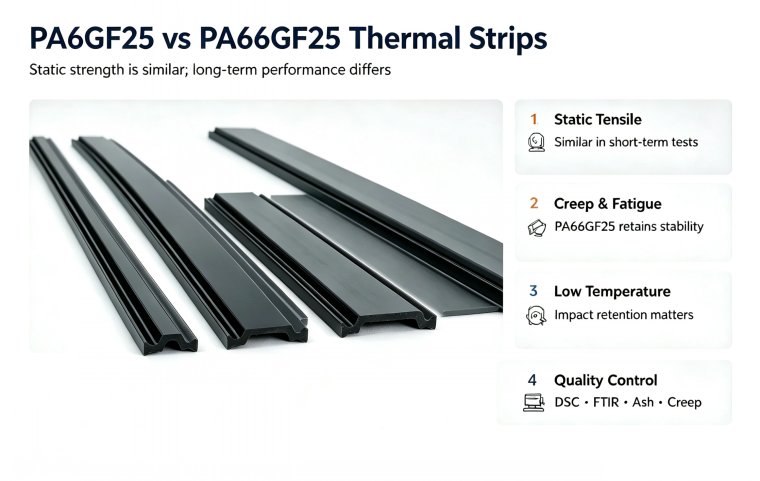
This paper compares PA6GF25 and PA66GF25 glass‑fiber‑reinforced polyamide thermal insulation strips for aluminum broken‑bridge profiles. Although their static room‑temperature tensile properties are similar, obvious differences exist in creep stability, fatigue resistance, low‑temperature performance, dimensional change and composite compatibility with aluminum alloy. PA6GF25 suffers greater deformation under temperature and humidity variation, lower post‑aging property retention and higher failure risk in harsh environments. PA66GF25 shows better long‑term matching with aluminum grooves and higher safety margin for high‑rise and cold‑region projects. Identification methods including DSC and FTIR are introduced to prevent mislabeling. Static tensile test alone is insufficient for material discrimination; climate, load and design life should be considered in material selection.
Introduction
Both PA6GF25 and PA66GF25 thermal insulation strips are glass‑fiber‑reinforced polyamide extruded profiles. In short‑term static tensile tests at room temperature, the difference in tensile values of some formulated samples is easily underestimated. However, in long‑term evaluation dimensions including dynamic fatigue, low‑temperature impact, creep, long‑term engagement with aluminum profiles after composite assembly, and property retention rate after aging, the gaps between the two materials keep expanding. This paper focuses on mechanical indicators, low‑temperature toughness, strip‑feeding composite compatibility, long‑term creep failure modes and identification test methods, and carries out a technical comparison for engineering application, providing reference for technical assessment of profile manufacturers, testing laboratories and window‑door systems.
I. Differences in Room‑Temperature Static Mechanical Properties and Dynamic Fatigue Performance
Under the standard environment of 23 ℃ and static tensile test conditions, PA6GF25 and PA66GF25 with the same glass fiber content have close ranges of longitudinal tensile strength. Some modified PA6 samples even present favorable initial tensile data, which is the main reason for the confusion of the two products in the market. Nevertheless, static tensile property is an instantaneous loading index and cannot reflect the long‑term stress conditions of windows and doors.
Inside profiles, broken‑bridge thermal insulation strips are continuously subjected to superposed static loads and alternating loads: dead load, wind pressure, push‑pull stress caused by thermal expansion and cold contraction, and micro‑vibration from earthquakes, falling into the working condition combining long‑term creep and fatigue. The molecular chains of the PA6 matrix have higher flexibility, leading to a higher creep rate under constant load and continuous accumulation of deformation over service time. The PA66 matrix features higher rigidity and greater resistance to molecular slippage, with lower long‑term creep deformation and superior dimensional stability under prolonged load.
Under repeated cyclic loading fatigue tests, PA6 suffers faster strength degradation after multiple stress cycles, and microcracks tend to initiate and propagate at the interface between glass fiber and resin. The resin matrix of PA66 has more stable interfacial bonding with glass fiber, offering a longer fatigue life and higher mechanical safety margin for high‑rise curtain walls, large‑grid windows and doors, and regions with heavy wind pressure.
II. Differences in Low‑Temperature Unnotched Impact Performance and Low‑Temperature Brittleness
Low‑temperature impact strength is a critical indicator for material selection in projects in frigid northern areas and high‑altitude regions. The neat PA6 resin boasts better low‑temperature toughness than PA66, which is prominent in unreinforced systems. After 25% glass fiber is added, however, the material toughening mechanism changes; glass fibers act as stress concentration points and greatly weaken the toughness advantage of the base resin.
PA6GF25 thermal insulation strips maintain acceptable impact values at around 0 ℃, yet the impact strength drops sharply and the risk of embrittlement rises when the temperature falls to -20 ℃ or -30 ℃ under severe cold conditions. PA66GF25 shows a gentler performance degradation curve in low‑temperature ranges, retaining a higher proportion of low‑temperature impact strength and having a lower critical temperature for brittle cracking.
There is a common misunderstanding in engineering: simply assuming that PA6 with better toughness is suitable for cold regions. This conclusion applies only to unreinforced nylon. Thermal insulation strips belong to glass‑fiber‑reinforced modified systems, so the toughness rule of neat resin cannot be directly adopted. For thermal strips of windows and doors in cold areas, besides impact strength, thermal stress fatigue induced by repeated alternation between low and high temperatures also needs to be considered. The PA6 matrix has a larger linear expansion coefficient and poorer matching with aluminum alloy than PA66, generating greater interfacial stress during temperature cycling and making internal microcracks more likely to form.
III. Linear Expansion Coefficient, Strip Engagement and Composite Compatibility with Aluminum Alloy Profiles
The linear expansion coefficient of aluminum alloy stays stable at approximately 23×10⁻⁶/℃. The core of long‑term matching between thermal insulation strips and aluminum profile grooves lies in keeping their linear expansion coefficients as close as possible to reduce interfacial shear stress triggered by temperature variation. PA6GF25 has a higher linear expansion coefficient than PA66GF25, meaning larger elongation when heated and greater shrinkage when cooled.
The strip‑feeding composite process presses thermal insulation strips into knurled grooves of aluminum profiles to form an integrally stressed structure through engagement of aluminum teeth. If the thermal strip has excessive thermal deformation, it will generate compressive internal stress inside the groove when elongating under summer heat; when contracting in winter, the clamping force of engaging teeth declines and loosening of engagement may occur. After repeated cycles, slippage appears at the composite interface and the overall thermal insulation structure of the profile fails, manifested as increased U‑value, water seepage in cavities and air leakage at profile joints.
Meanwhile, dimensional expansion and contraction of PA6 caused by moisture absorption superposes thermal deformation. It swells by absorbing moisture in hot and humid seasons and shrinks by losing moisture in dry seasons. Such dual dimensional fluctuations continuously damage the knurled engagement structure. PA66 has a lower moisture absorption rate and smaller dimensional fluctuation induced by the coupling of temperature and humidity, delivering better long‑term stability of the composite structure with aluminum profiles. This long‑term matching difference becomes more obvious when supporting system windows and doors and injection‑bonded composite profiles.
IV. Property Retention after Aging and Differentiation of Typical Failure Modes
Artificial accelerated aging tests (UV aging, hygrothermal aging and thermal aging) are methods to predict the long‑term service life of thermal insulation strips. After aging tests of equal duration, PA6GF25 achieves lower retention rates of tensile strength and impact strength than PA66GF25.
Typical failure paths of PA6 thermal insulation strips: high‑temperature creep → dimensional shrinkage / elongation → loose engagement → seal failure; sustained low‑temperature impact plus alternating stress → matrix brittle fracture; long‑term hygrothermal moisture absorption → interfacial debonding and exposed glass fibers. Failures of PA66 thermal strips mostly stem from production defects such as recycled raw material adulteration, insufficient glass fiber content and excessive internal stress generated during extrusion. With qualified raw materials, PA66 has a gentle aging degradation curve and a longer failure cycle.
It should be clarified that a faster failure rate does not mean PA6 cannot be used. Instead, they differ in failure mechanism, safety margin and designed service life. PA6 can be applied in some scenarios for low‑rise simple windows and doors with short design life and mild load conditions. For high‑rise buildings, ultra‑low‑energy buildings and coastal highly corrosive environments requiring high long‑term stability, the safety margin of PA6 systems cannot meet the design service life.
V. On‑site and Laboratory Identification, Sampling Inspection and Judgment Methods
Besides DSC melting temperature testing, multiple detection methods can be combined to distinguish the two types of thermal strips. Fourier‑transform infrared spectroscopy (FTIR) can directly identify characteristic absorption peaks of the resin matrix and qualitatively determine whether the substrate is PA6 or PA66. Ash content testing verifies the filling ratio of glass fiber to rule out insufficient glass fiber addition. High‑low temperature cycling tests and creep tests quantify differences in long‑term deformation.
Some suppliers in the market mislabel PA6GF25 thermal insulation strips as PA66GF25, taking advantage of their similar static tensile data to substitute inferior products, which brings risks in later project re‑inspection and energy‑saving acceptance. Profile manufacturers should not only conduct room‑temperature tensile tests for incoming sampling inspection, but also add DSC melting peak qualitative analysis to confirm the substrate type.
The technical procurement agreement shall specify the substrate type, applicable standards and test items, and distinguish whether GB/T 23615.1‑2017 for PA66 substrate is adopted or define technical indicators and acceptance limits for PA6 substrate to avoid quality disputes in later stages.
Conclusion
The mechanical gaps between PA6GF25 and PA66GF25 thermal insulation strips mainly lie in creep stability, fatigue resistance, low‑temperature property retention and long‑term engagement matching with aluminum profiles. Static tensile testing can only serve as a basic screening indicator rather than a basis for substrate identification. During type selection and evaluation, comprehensive judgment combining wind pressure grade, service climate, building height, designed service life and acceptance criteria is required, and a complete system of incoming inspection and performance assessment shall be established.