
Mechanism, Defect Characteristics and Hazards of Insulation Strip End Deformation Caused by Poor Mould Dimensional Accuracy
This article focuses on the quality defect of the PA66GF25 heat insulation strip at the end, analyzing the forming mechanism and typical fault types of the deformation caused by the mold accuracy defect, elaborating on its harm to the assembly accuracy of doors and windows, energy-saving sealing and production after-sales, and proposing standardized measures for source control such as mold accuracy management, calibration and dedicated mold for specific use.
End‑deformation of PA66GF25 thermal‑insulation strips constitutes a high‑frequency quality defect during door‑and‑window fabrication, assembly and subsequent service. Its main manifestations include warped cut ends, flared edges, width deviation, corner collapse and end asymmetry. Severe cases feature local end twisting and cross‑section distortion, which directly impair the assembly precision of inserted strips and the structural stability of composite profiles.Practical production quality‑control inspections reveal that the latent cause for most end‑deformation faults does not lie in subsequent storage, transportation or cutting operations. Instead, it refers to inherent structural deficiencies triggered by substandard dimensional accuracy of core production moulds. Serving as the benchmark carrier for thermal‑insulation strip forming, the mould can concentrate its die‑opening dimension errors, asymmetric cavities and defective corner precision on strip ends, thereby generating persistent, batch‑wise end‑deformation failures. This paper conducts an in‑depth analysis of the underlying mechanism, typical defect traits and engineering‑level risks of end deformation induced by mould inaccuracy, and furnishes professional references for production quality management and defect rectification.
I. Core Mechanism of End‑Part Deformation Triggered by Mould Precision Defects
PA66 thermal‑insulation strips are manufactured via high‑temperature melt extrusion moulding. The molten material reproduces the cross‑section profile through the mould cavity, and finished strip ends are obtained after shaping, cooling and cutting‑to‑length. As the cut‑off opening of the profile cross‑section, the strip end most intuitively reflects mould‑forming accuracy. A high‑precision mould boasts regular cavity dimensions, symmetrical corners and balanced material outflow from runners. The extruded profile maintains consistent cross‑section geometry throughout its length, yielding flat, square‑cut ends free from deformation or offset after cutting.
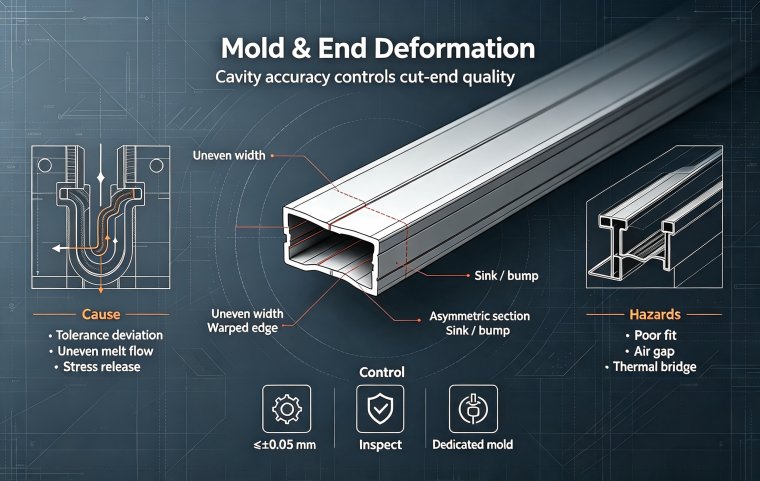
Moulds with poor dimensional accuracy commonly suffer from uneven die‑opening width, worn and displaced cavity corners, unbalanced resistance between left‑side and right‑side runners, and radian deviation at the end‑shaping zone. During nylon‑glass‑fibre melt extrusion, material outflow velocity and melt pressure differ sharply across cross‑section zones, building non‑uniform internal stress inside the profile. Such latent stress accumulates all over the strip. Stress is released instantly upon cutting and concentrates on the strip end, resulting in observable deformation defects including end warpage, distortion and corner displacement.
Unlike the profile’s middle section restrained by integrated structure, the insulation‑strip end serves as a free cross‑section without tension or structural restriction from adjacent profile segments. Stress discrepancies originating from mould inaccuracy get fully released at the end. This explains why mould dimensional flaws mostly manifest as end deformation, an irreversible inherent moulding defect.
II. Typical Categories of End‑Part Deformation Caused by Insufficient Mould Precision
First, width offset deformation at the strip end. Unilateral deviation of the mould die‑opening dimension and uneven cavity wear bring about minor width discrepancies on the extruded profile cross‑section. The cut end turns out uneven‑sided in width. Such offset deformation prevents precise fitting with the aluminium profile groove. One‑sided jamming and uneven gaps frequently occur during strip insertion.
Second, corner warping and flanged‑edge deformation on the end. Insufficient polishing accuracy and tiny irregularities on the mould cavity corners cause uneven cooling and shaping within corner zones during melt forming. Localised stress builds up and induces slight upward or downward warping of end corners after cutting, which creates bulging‑edge defects. Hard compression against profile groove walls emerges after installation and generates persistent assembly‑induced stress.
Third, asymmetrical cross‑section deformation of the strip end. Asymmetric runner diversion frameworks and dimension errors inside the sizing cavity produce inconsistent left‑and‑right thickness and radian on the profile cross‑section. The tilted, asymmetrical end geometry breaks the coordinated fit between thermal‑insulation strips and aluminium profiles and gives rise to eccentric assembly loading.
Fourth, local sinking and uneven deformation on the strip end. Low‑grade moulds suffer from poor die‑opening precision, built‑up material protrusions and worn‑out pits inside the cavity. These flaws are replicated onto the profile cross‑section and trigger indentations, bumps and irregular end surfaces, which severely impair the attaching precision of the matched profiles.
III. Engineering Hazards of End‑Part Deformation Caused by Mould Precision Defects
To begin with, assembly accuracy is compromised and composite‑profile stability deteriorates. Deformed ends of thermal‑insulation strips cannot slide smoothly into the grooves of aluminium profiles. Workers often force the strips into place under compression during manufacturing. Such forced assembly deforms profile grooves and locks residual stress inside insulation strips. When the doors and windows go into service afterwards, profile twisting, sash distortion and loose corner joints are highly likely to occur.
Secondly, chaotic fitting gaps impair energy‑saving and sealing performance. Deformed strip ends prevent tight contact between insulation strips and aluminium profiles. Local gaps and vacant spaces create invisible air‑convection passages and build thermal bridges across profiles, which drastically cuts down the heat‑insulating capacity of doors and windows. Uneven contact of sealing gaskets will further bring on recurring troubles such as air leakage, water seepage and weakened sound insulation.
Lastly, material waste and after‑sales risks rise. Insulation strips with deformed ends are unfit for standard assembly, hence pushing up scrap and rework rates and raising manufacturing costs. Since this defect belongs to an inherent structural flaw, ongoing stress release during service may trigger end cracking and extended fractures, which poses batch‑scale hidden troubles for construction‑project after‑sales maintenance.
IV. Standardized Prevention‑and‑Control Measures against End‑Part Deformation from Mould‑Related Factors
First, strictly control mould machining accuracy. Before newly‑made moulds are put into production, comprehensive inspection shall be carried out on die‑opening dimensions, cavity symmetry, corner precision and runner uniformity. All mould tolerances shall comply with the high‑precision national standard of ±0.05 mm. Moulds failing accuracy inspection are prohibited from trial operation and formal production.
Second, implement a regular mould calibration system. Mass‑production moulds shall be disassembled periodically for cavity‑wear inspection. Operators shall conduct timely polishing to rectify corner deviations and perform repair welding on worn spots, so as to prevent batch end‑part deformation resulting from mould‑accuracy degradation.
Third, enforce the dedicated‑mould policy. Assign exclusive moulds for thermal‑insulation strips of distinct specifications and precision grades. Interchangeable mould usage is forbidden. Mismatch between cavity dimensions and product specifications can thereby be avoided to prevent forming‑induced deformation defects.
Conclusion
Thermal insulation strip end deformation is not a simple problem caused by cutting technology. Poor dimensional accuracy of moulds is the core inherent inducement of such defects. Tiny dimensional deviations, structural asymmetry and insufficient corner precision of mould cavities will be converted into internal stress inside the profiles, which is eventually released at the strip ends and leads to deformation. Strictly controlling the machining and maintenance accuracy of moulds to eliminate forming stress deviations from the source is the key measure to avoid mould-induced end deformation, and guarantee the assembly accuracy and engineering quality of thermal insulation strips.
I. Core Mechanism of End‑Part Deformation Triggered by Mould Precision Defects
PA66 thermal‑insulation strips are manufactured via high‑temperature melt extrusion moulding. The molten material reproduces the cross‑section profile through the mould cavity, and finished strip ends are obtained after shaping, cooling and cutting‑to‑length. As the cut‑off opening of the profile cross‑section, the strip end most intuitively reflects mould‑forming accuracy. A high‑precision mould boasts regular cavity dimensions, symmetrical corners and balanced material outflow from runners. The extruded profile maintains consistent cross‑section geometry throughout its length, yielding flat, square‑cut ends free from deformation or offset after cutting.
Moulds with poor dimensional accuracy commonly suffer from uneven die‑opening width, worn and displaced cavity corners, unbalanced resistance between left‑side and right‑side runners, and radian deviation at the end‑shaping zone. During nylon‑glass‑fibre melt extrusion, material outflow velocity and melt pressure differ sharply across cross‑section zones, building non‑uniform internal stress inside the profile. Such latent stress accumulates all over the strip. Stress is released instantly upon cutting and concentrates on the strip end, resulting in observable deformation defects including end warpage, distortion and corner displacement.
Unlike the profile’s middle section restrained by integrated structure, the insulation‑strip end serves as a free cross‑section without tension or structural restriction from adjacent profile segments. Stress discrepancies originating from mould inaccuracy get fully released at the end. This explains why mould dimensional flaws mostly manifest as end deformation, an irreversible inherent moulding defect.
II. Typical Categories of End‑Part Deformation Caused by Insufficient Mould Precision
First, width offset deformation at the strip end. Unilateral deviation of the mould die‑opening dimension and uneven cavity wear bring about minor width discrepancies on the extruded profile cross‑section. The cut end turns out uneven‑sided in width. Such offset deformation prevents precise fitting with the aluminium profile groove. One‑sided jamming and uneven gaps frequently occur during strip insertion.
Second, corner warping and flanged‑edge deformation on the end. Insufficient polishing accuracy and tiny irregularities on the mould cavity corners cause uneven cooling and shaping within corner zones during melt forming. Localised stress builds up and induces slight upward or downward warping of end corners after cutting, which creates bulging‑edge defects. Hard compression against profile groove walls emerges after installation and generates persistent assembly‑induced stress.
Third, asymmetrical cross‑section deformation of the strip end. Asymmetric runner diversion frameworks and dimension errors inside the sizing cavity produce inconsistent left‑and‑right thickness and radian on the profile cross‑section. The tilted, asymmetrical end geometry breaks the coordinated fit between thermal‑insulation strips and aluminium profiles and gives rise to eccentric assembly loading.
Fourth, local sinking and uneven deformation on the strip end. Low‑grade moulds suffer from poor die‑opening precision, built‑up material protrusions and worn‑out pits inside the cavity. These flaws are replicated onto the profile cross‑section and trigger indentations, bumps and irregular end surfaces, which severely impair the attaching precision of the matched profiles.
III. Engineering Hazards of End‑Part Deformation Caused by Mould Precision Defects
To begin with, assembly accuracy is compromised and composite‑profile stability deteriorates. Deformed ends of thermal‑insulation strips cannot slide smoothly into the grooves of aluminium profiles. Workers often force the strips into place under compression during manufacturing. Such forced assembly deforms profile grooves and locks residual stress inside insulation strips. When the doors and windows go into service afterwards, profile twisting, sash distortion and loose corner joints are highly likely to occur.
Secondly, chaotic fitting gaps impair energy‑saving and sealing performance. Deformed strip ends prevent tight contact between insulation strips and aluminium profiles. Local gaps and vacant spaces create invisible air‑convection passages and build thermal bridges across profiles, which drastically cuts down the heat‑insulating capacity of doors and windows. Uneven contact of sealing gaskets will further bring on recurring troubles such as air leakage, water seepage and weakened sound insulation.
Lastly, material waste and after‑sales risks rise. Insulation strips with deformed ends are unfit for standard assembly, hence pushing up scrap and rework rates and raising manufacturing costs. Since this defect belongs to an inherent structural flaw, ongoing stress release during service may trigger end cracking and extended fractures, which poses batch‑scale hidden troubles for construction‑project after‑sales maintenance.
IV. Standardized Prevention‑and‑Control Measures against End‑Part Deformation from Mould‑Related Factors
First, strictly control mould machining accuracy. Before newly‑made moulds are put into production, comprehensive inspection shall be carried out on die‑opening dimensions, cavity symmetry, corner precision and runner uniformity. All mould tolerances shall comply with the high‑precision national standard of ±0.05 mm. Moulds failing accuracy inspection are prohibited from trial operation and formal production.
Second, implement a regular mould calibration system. Mass‑production moulds shall be disassembled periodically for cavity‑wear inspection. Operators shall conduct timely polishing to rectify corner deviations and perform repair welding on worn spots, so as to prevent batch end‑part deformation resulting from mould‑accuracy degradation.
Third, enforce the dedicated‑mould policy. Assign exclusive moulds for thermal‑insulation strips of distinct specifications and precision grades. Interchangeable mould usage is forbidden. Mismatch between cavity dimensions and product specifications can thereby be avoided to prevent forming‑induced deformation defects.
Conclusion
Thermal insulation strip end deformation is not a simple problem caused by cutting technology. Poor dimensional accuracy of moulds is the core inherent inducement of such defects. Tiny dimensional deviations, structural asymmetry and insufficient corner precision of mould cavities will be converted into internal stress inside the profiles, which is eventually released at the strip ends and leads to deformation. Strictly controlling the machining and maintenance accuracy of moulds to eliminate forming stress deviations from the source is the key measure to avoid mould-induced end deformation, and guarantee the assembly accuracy and engineering quality of thermal insulation strips.