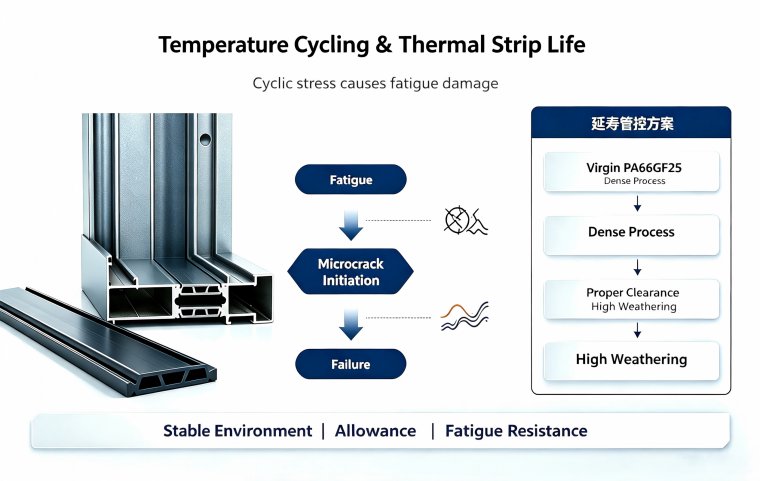
Compared with the single temperature effect of constant high or low temperature, the cyclic temperature changes caused by seasonal alternation, day-night temperature difference, sunshine exposure and rain erosion in the natural environment serve as the core factor leading to fatigue failure and significant service life attenuation of thermal break strips. Numerous engineering cases have verified that thermal break strips suffer barely any aging damage in a constant temperature environment. In contrast, outdoor working conditions with repeated temperature fluctuations are the main inducement for cracking, deformation, debonding, pulverization and failure of thermal break strips. The reciprocating deformation stress generated by temperature cycling continuously consumes the fatigue life of materials, accumulates structural damage gradually, and ultimately leads to premature scrapping of products. This paper conducts an in-depth analysis of the failure mechanism of temperature cycling, typical temperature fatigue defects, service life attenuation rules, as well as the full-process quality control scheme for service life extension.
I. Core Mechanism of Service Life Attenuation Caused by Thermal Cycling Fatigue
PA66 resin, glass fibers, and aluminum alloy profiles feature distinct coefficients of thermal expansion and contraction. Among them, PA66 thermal break strips have the highest thermal expansion coefficient, while aluminum profiles have the lowest. Under cyclic temperature variations between day and night as well as winter and summer, aluminum profiles and thermal break strips undergo asynchronous expansion and contraction, generating continuous reciprocating tensile stress inside the composite structure, namely thermal fatigue stress.
Each thermal expansion during temperature rise and thermal contraction during temperature drop subjects the thermal break strip to alternating tensile and compressive loads. Long-term and high-frequency temperature cycling keeps the material under persistent fatigue stress. The internal molecular chains are repeatedly stretched and retracted, gradually resulting in fatigue damage, slippage and fracture. The interfaces between glass fibers and the resin undergo repeated debonding and re-bonding, eventually forming permanent microscopic voids and cracks. This thoroughly destroys the dense structure of the material, causing a cliff-like decline in the performance of thermal break strips and greatly shortening their service life.
II. Phased‑Service‑Life Failure Defects Triggered by Temperature Difference Cycles
The first phase refers to latent fatigue loss. Within one to two years of service, no obvious surface change can be observed. Nevertheless, internal material‑based fatigue damage accumulates, accompanied by slight deterioration in toughness and impact resistance. This kind of service‑life loss remains invisible to the naked eye.
The second phase marks the initiation of microscopic defects. After three to five‑year‑long accumulated temperature cycles, tiny whitish patches, localized dull surfaces and superficial micro‑cracks emerge on the thermal‑break‑strip surface. Material toughness drops sharply and deformation resistance keeps decreasing, kicking off rapid ageing.
The third phase is structural failure. Following five to eight years of sustained fatigue, micro‑cracks grow into penetrating fractures and wall cracks. The thermal break strip suffers distortion, loosening and breakage, which disables the broken‑bridge structure. Heat insulation, sealing performance and structural safety of doors and windows collapse entirely, and the product reaches the end of its usable lifespan.
III. Direct Influence of Temperature‑Difference Range and Cycling Frequency on Service Life
Larger temperature‑difference ranges and higher cycling frequencies shorten the fatigue life of thermal break strips. In regions with distinct four‑season cycles and sharp day‑night temperature gaps, the winter‑summer temperature span can exceed 60 °C and diurnal temperature variation surpasses 20 °C. Frequent drastic temperature shifts subject thermal break strips to long‑term high‑intensity fatigue conditions and accelerate service‑life deterioration.
By contrast, areas with mild temperature fluctuations generate low thermal stress and minor deformation. Material fatigue loss stays minimal, enabling thermal break strips to sustain stable properties and attain their designed service life. Besides, dark‑toned profiles and unshaded doors‑and‑windows under direct sunlight undergo wider daily temperature rises and falls. They accumulate far more severe fatigue damage than shaded or light‑coloured window assemblies and are more prone to premature ageing.
IV. Core Solutions for Alleviating Thermal Fatigue and Prolonging the Service Life of Thermal Break Strips
At the raw material level, national standard PA66GF25 thermal break strips made of virgin materials shall be adopted. Virgin materials feature complete molecular chains and tight bonding with glass fibers, delivering excellent fatigue resistance and capable of withstanding long-term cyclic thermal stress caused by temperature differences. Recycled materials and blended materials are strictly prohibited, as such materials have inherent poor fatigue resistance and are highly susceptible to rapid failure under alternating temperature conditions.
At the processing level, the extrusion, drying and shaping processes are strictly controlled to ensure the thermal break strips have a dense internal structure without porosity, bubbles or residual stress. The uniform and stable structural performance effectively improves the overall thermal fatigue resistance and reduces the accumulation of damage induced by temperature deformation.
At the assembly level, the fitting clearance between profiles and thermal break strips is strictly controlled to maintain a reasonable micro-clearance and reserve allowance for thermal expansion and contraction. This avoids rigid extrusion stress during temperature-induced deformation and significantly reduces fatigue loss.
At the application level, engineering selection is optimized. National standard thermal break strips with high weather resistance and high fatigue resistance are prioritized for use in regions with intense solar radiation and extreme cold climates. Matching with light-colored profiles can reduce cavity heat accumulation and temperature fluctuation amplitude, thereby slowing down the aging rate of the strips.
V. Industrial Quality Significance of Thermal Life Extension Management
The actual service life of thermal break strips is never determined by factory technical parameters, but by long-term thermal operating conditions and accumulated fatigue damage. A stable temperature environment, reasonable deformation allowance, and high-quality fatigue-resistant materials constitute the three core elements for achieving an ultra-long service life of thermal break strips. Attaching importance to the impact of temperature on product durability and avoiding thermal fatigue damage can fundamentally resolve common industry problems of doors and windows, including premature aging, cracking, water leakage, and failure of energy-saving performance, so as to substantially improve the full-life-cycle quality of door and window engineering projects.
Conclusion
If constant temperature determines the aging rate of thermal break strips, thermal cycling fatigue determines their ultimate service life. Reciprocating stress induced by alternating cold and hot conditions serves as the primary cause of thermal break strip failure. Only by adopting national-standard materials with high fatigue resistance, standardizing assembly clearances, and matching products with local temperature conditions can aging degradation be maximally delayed. This enables thermal break strips to maintain long-term stable structural and thermal insulation performance, and ensures long-term safety, energy efficiency and durability of thermal-broken aluminum doors and windows.