
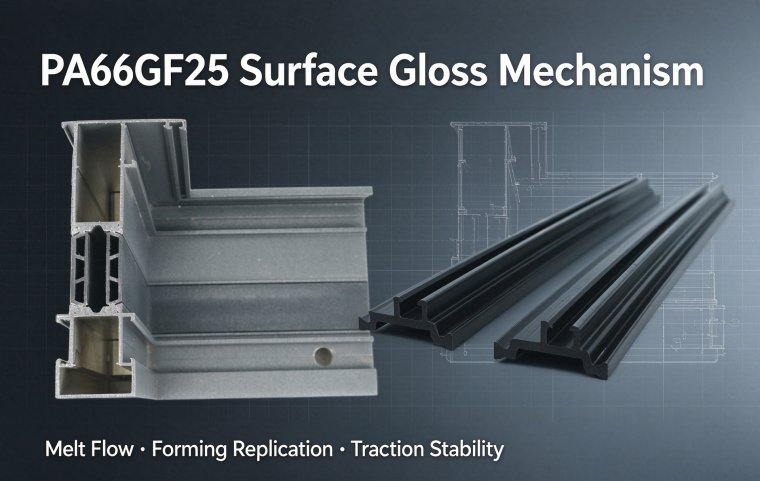
Formation Mechanism of Bright Surface on PA66GF25 Thermal Strips and Positive Process Factors
This article analyzes the bright surface formation mechanism of PA66GF25 thermal strips and key process factors. Surface gloss depends on surface micro-morphology and does not equal material performance. Raw materials, extrusion temperature, vacuum calibration, cooling and traction affect melt leveling. Real gloss is different from false gloss induced by excess lubricants or overheating. Gloss should serve as a process indicator instead of a production target.
I. Physical Nature and Evaluation Boundary of Surface Gloss
The surface gloss of finished PA66GF25 thermal strips is an auxiliary appearance indicator for matching broken-bridge aluminum doors and windows, and it does not equate to product performance by itself. Physically, surface gloss originates from the micro-morphology of the melt surface layer formed between the die lip outlet and the inner wall of the calibrator sleeve. A flat surface layer with tiny micro-undulations, no exposed glass fibers, pits or specks increases the proportion of specular reflection on the material surface, creating a bright appearance to the naked eye. If floating fibers, flow marks, micro-pits or precipitates attach to the surface, light undergoes diffuse reflection and the part appears matte.
A fundamental judgment should be clarified: gloss is only a surface phenomenon, and gloss formed through different routes may have completely different implications. Two equally bright thermal strips can be produced either by sufficient melt wetting and leveling, or by excessive enrichment of lubricating additives with glass fibers concealed beneath the surface. The latter case is often accompanied by reduced interfacial bonding strength and scattered mechanical properties. Therefore, gloss should not be set as a standalone acceptance criterion in raw material and finished product inspection; instead, it serves as an auxiliary clue for troubleshooting process conditions.
II. Underlying Influence of Raw Material System on Base Gloss
The molecular weight distribution and melt flowability of PA66 resin govern the spreading capacity of the melt inside the die cavity and against the calibrator inner wall. Grades with higher flowability and narrower molecular weight distribution spread more readily after melting, easily forming a continuous and smooth surface layer against the inner wall for higher finished gloss. Low-flow grades exhibit weaker spreading tendency, and their surfaces tend to develop faint flow marks and undulations for a duller look.
Glass fiber specifications also directly affect surface condition. Coarse-diameter glass fibers are more likely to form micro-protrusions on the surface, or even pierce the melt film at the die lip and become exposed. Fine-diameter glass fibers sized with coupling agents compatible with the PA66 matrix can be fully encapsulated by resin, maintaining a continuous surface and delivering better gloss. Failed coupling agents reduce interfacial bonding and trigger micro-separation between glass fibers and the matrix. Even with acceptable initial appearance, the surface will peel and turn hazy after long-term hydrothermal aging.
Internal and external lubricants in the formulation exert a notable effect on demolding and surface finish. Appropriate internal lubrication improves internal melt flow, while external lubricants accumulate on the surface to lower friction between the melt and metal die walls, preventing the surface from being scratched by the calibrator and boosting smoothness. However, lubricants are low-molecular-weight components. When dosed beyond the reasonable range, they migrate and form a thin film on the surface to falsely raise gloss, while weakening interfacial adhesion and hydrolysis resistance.
III. Regulation of Surface Leveling by Extrusion Temperature Profile
Within a proper temperature window, moderately raising temperatures in the melting zone and die section reduces PA66 melt viscosity and enhances leveling capacity. Fine turbulent marks emerging at the die lip outlet get smoothed out, yielding a smoother, brighter surface after calibration. Temperature uniformity across die zones is critical. Large temperature deviations front-to-back or side-to-side across the die cause inconsistent local melt viscosity, resulting in uneven brightness where one side of a thermal strip is bright and the other hazy. This defect is more common on wide I-shaped profiles and multi-cavity strips.
Temperature elevation has a clear upper limit. Exceeding the valid range triggers thermal degradation of PA66, breaking molecular chains and increasing end groups, which degrades tensile strength and hydrolysis resistance of the bulk material. Although the surface may appear bright temporarily, it tends to peel, develop fine cracks and lose gloss rapidly after boiling water tests or thermal cycling. Improving appearance solely by overheating to cut viscosity sacrifices long-term performance and fails to meet the service requirements of doors, windows and curtain walls.
IV. Surface Replication Effect of the Calibration System
The surface morphology of the thermal strip is initially shaped as it exits the die lip, while the calibration stage determines the final surface state. The surface finish of the vacuum calibrator inner wall is nearly replicated onto the extrudate. A highly polished inner wall free of scratches, carbon deposits and additive scale transfers a mirror effect. Worn inner walls or walls coated with precipitate scale produce hazy surfaces, linear scratches or pitted textures on the product.
Vacuum negative pressure must match the extrusion speed. Proper negative pressure presses the hot melt tightly against the smooth inner wall, flattening minor surface undulations and improving gloss. Insufficient negative pressure leaves gaps between the profile and calibrator sleeve; the surface cools and shrinks freely with amplified undulations and reduced gloss. Excessively high negative pressure, by contrast, drags and injures the soft melt surface, creating linear drag marks and ruining surface smoothness.
Cooling gradient also impacts surface quality. Gentle staged cooling allows slow surface solidification and gives the melt sufficient time to complete leveling. Sharp water quenching freezes the surface instantly, interrupting the leveling process and lowering gloss. It also builds substantial residual stress inside the cross-section, laying groundwork for subsequent warpage and cracking.
V. Traction Synchronization and Surface Stability
When traction speed strictly synchronizes with main extruder throughput, the melt bears uniform longitudinal stress after exiting the die. The surface avoids periodic stretching or compression for stable micro-morphology. Fluctuating traction speed, crawler slippage or asymmetric clamping pressure on both sides subjects the profile surface to cyclic tension and compression, generating subtle ripples that ruin bright texture and causing dimensional drift along the profile length.
For multi-outlet extrusion with multiple strips per die, traction tension for every strip must remain consistent. Minor flow mismatches paired with unbalanced tension leave some strips under continuous tension and others relaxed, leading to inconsistent surface leveling and gloss variation among parts from the same die.
VI. Conclusion: Distinction Between Genuine Brightness and Process-induced Artificial Brightness
Genuine brightness formed under normal processes stems from sufficient melt wetting, uniform leveling and intimate contact with the smooth calibrator inner wall. It relies on stable moisture control, reasonable shear configuration and symmetric cooling conditions. Products of this type usually feature favorable glass fiber dispersion and consistent mechanical performance. High gloss obtained via excessive lubricants, overheating viscosity reduction or over-polished dies is merely superficial modification, and is often accompanied by weakened interfacial bonding and poorer hydrolysis resistance.
Manufacturers should regard gloss as an indicator of process state rather than a target to pursue. When gloss changes obviously for the same formulation and specification, troubleshooting raw material batches, drying condition, die cleanliness and calibrator wall condition is more effective than simply adjusting temperature or adding more lubricants to identify root causes.
The surface gloss of finished PA66GF25 thermal strips is an auxiliary appearance indicator for matching broken-bridge aluminum doors and windows, and it does not equate to product performance by itself. Physically, surface gloss originates from the micro-morphology of the melt surface layer formed between the die lip outlet and the inner wall of the calibrator sleeve. A flat surface layer with tiny micro-undulations, no exposed glass fibers, pits or specks increases the proportion of specular reflection on the material surface, creating a bright appearance to the naked eye. If floating fibers, flow marks, micro-pits or precipitates attach to the surface, light undergoes diffuse reflection and the part appears matte.
A fundamental judgment should be clarified: gloss is only a surface phenomenon, and gloss formed through different routes may have completely different implications. Two equally bright thermal strips can be produced either by sufficient melt wetting and leveling, or by excessive enrichment of lubricating additives with glass fibers concealed beneath the surface. The latter case is often accompanied by reduced interfacial bonding strength and scattered mechanical properties. Therefore, gloss should not be set as a standalone acceptance criterion in raw material and finished product inspection; instead, it serves as an auxiliary clue for troubleshooting process conditions.
II. Underlying Influence of Raw Material System on Base Gloss
The molecular weight distribution and melt flowability of PA66 resin govern the spreading capacity of the melt inside the die cavity and against the calibrator inner wall. Grades with higher flowability and narrower molecular weight distribution spread more readily after melting, easily forming a continuous and smooth surface layer against the inner wall for higher finished gloss. Low-flow grades exhibit weaker spreading tendency, and their surfaces tend to develop faint flow marks and undulations for a duller look.
Glass fiber specifications also directly affect surface condition. Coarse-diameter glass fibers are more likely to form micro-protrusions on the surface, or even pierce the melt film at the die lip and become exposed. Fine-diameter glass fibers sized with coupling agents compatible with the PA66 matrix can be fully encapsulated by resin, maintaining a continuous surface and delivering better gloss. Failed coupling agents reduce interfacial bonding and trigger micro-separation between glass fibers and the matrix. Even with acceptable initial appearance, the surface will peel and turn hazy after long-term hydrothermal aging.
Internal and external lubricants in the formulation exert a notable effect on demolding and surface finish. Appropriate internal lubrication improves internal melt flow, while external lubricants accumulate on the surface to lower friction between the melt and metal die walls, preventing the surface from being scratched by the calibrator and boosting smoothness. However, lubricants are low-molecular-weight components. When dosed beyond the reasonable range, they migrate and form a thin film on the surface to falsely raise gloss, while weakening interfacial adhesion and hydrolysis resistance.
III. Regulation of Surface Leveling by Extrusion Temperature Profile
Within a proper temperature window, moderately raising temperatures in the melting zone and die section reduces PA66 melt viscosity and enhances leveling capacity. Fine turbulent marks emerging at the die lip outlet get smoothed out, yielding a smoother, brighter surface after calibration. Temperature uniformity across die zones is critical. Large temperature deviations front-to-back or side-to-side across the die cause inconsistent local melt viscosity, resulting in uneven brightness where one side of a thermal strip is bright and the other hazy. This defect is more common on wide I-shaped profiles and multi-cavity strips.
Temperature elevation has a clear upper limit. Exceeding the valid range triggers thermal degradation of PA66, breaking molecular chains and increasing end groups, which degrades tensile strength and hydrolysis resistance of the bulk material. Although the surface may appear bright temporarily, it tends to peel, develop fine cracks and lose gloss rapidly after boiling water tests or thermal cycling. Improving appearance solely by overheating to cut viscosity sacrifices long-term performance and fails to meet the service requirements of doors, windows and curtain walls.
IV. Surface Replication Effect of the Calibration System
The surface morphology of the thermal strip is initially shaped as it exits the die lip, while the calibration stage determines the final surface state. The surface finish of the vacuum calibrator inner wall is nearly replicated onto the extrudate. A highly polished inner wall free of scratches, carbon deposits and additive scale transfers a mirror effect. Worn inner walls or walls coated with precipitate scale produce hazy surfaces, linear scratches or pitted textures on the product.
Vacuum negative pressure must match the extrusion speed. Proper negative pressure presses the hot melt tightly against the smooth inner wall, flattening minor surface undulations and improving gloss. Insufficient negative pressure leaves gaps between the profile and calibrator sleeve; the surface cools and shrinks freely with amplified undulations and reduced gloss. Excessively high negative pressure, by contrast, drags and injures the soft melt surface, creating linear drag marks and ruining surface smoothness.
Cooling gradient also impacts surface quality. Gentle staged cooling allows slow surface solidification and gives the melt sufficient time to complete leveling. Sharp water quenching freezes the surface instantly, interrupting the leveling process and lowering gloss. It also builds substantial residual stress inside the cross-section, laying groundwork for subsequent warpage and cracking.
V. Traction Synchronization and Surface Stability
When traction speed strictly synchronizes with main extruder throughput, the melt bears uniform longitudinal stress after exiting the die. The surface avoids periodic stretching or compression for stable micro-morphology. Fluctuating traction speed, crawler slippage or asymmetric clamping pressure on both sides subjects the profile surface to cyclic tension and compression, generating subtle ripples that ruin bright texture and causing dimensional drift along the profile length.
For multi-outlet extrusion with multiple strips per die, traction tension for every strip must remain consistent. Minor flow mismatches paired with unbalanced tension leave some strips under continuous tension and others relaxed, leading to inconsistent surface leveling and gloss variation among parts from the same die.
VI. Conclusion: Distinction Between Genuine Brightness and Process-induced Artificial Brightness
Genuine brightness formed under normal processes stems from sufficient melt wetting, uniform leveling and intimate contact with the smooth calibrator inner wall. It relies on stable moisture control, reasonable shear configuration and symmetric cooling conditions. Products of this type usually feature favorable glass fiber dispersion and consistent mechanical performance. High gloss obtained via excessive lubricants, overheating viscosity reduction or over-polished dies is merely superficial modification, and is often accompanied by weakened interfacial bonding and poorer hydrolysis resistance.
Manufacturers should regard gloss as an indicator of process state rather than a target to pursue. When gloss changes obviously for the same formulation and specification, troubleshooting raw material batches, drying condition, die cleanliness and calibrator wall condition is more effective than simply adjusting temperature or adding more lubricants to identify root causes.