
Mechanism Influencing the Service Life of PA66GF25 Thermal Strips and Its Evaluation System
This paper analyzes aging mechanisms and evaluation system for PA66GF25 thermal strips. It discusses influencing factors and notes that mechanical retention, not appearance, determines their service life.
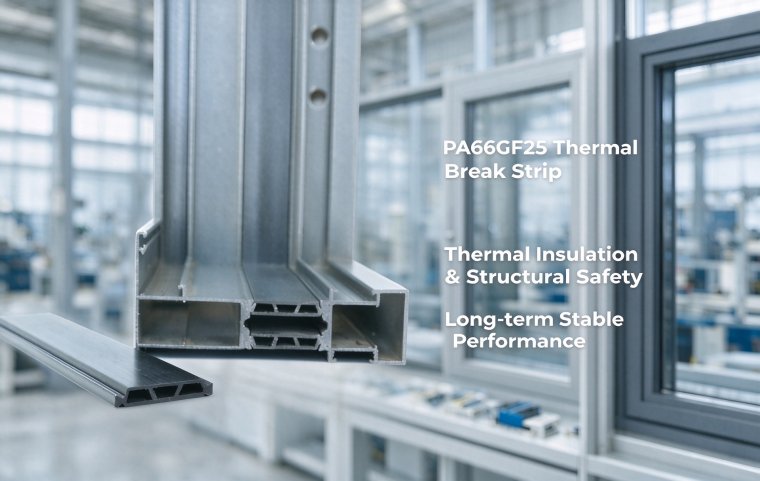
In thermal break aluminum window and door systems, PA66GF25 thermal strips are core components that perform dual functions of thermal insulation and structural connection. Their service life directly determines the thermal insulation performance, structural safety and long-term service stability of the entire window and door assembly. The industry often states that windows and doors can last 20 or 25 years, which is premised on the supporting thermal strips maintaining stable material properties without rapid degradation under alternating natural environments. There is no fixed service life value for thermal strips. Their lifespan is a combined result of material formulation, production processes, profile assembly and service conditions. It cannot be simply judged as failed only by whether the appearance remains intact. In accordance with the GB/T 23615 series of standards, the durability of thermal strips shall be comprehensively assessed through multiple tests including mechanical property retention rate, hydrolysis resistance, thermal aging and low-temperature impact. These accelerated aging tests are essentially used to predict the service life of materials in real natural service environments.
The molecular structure of PA66 polyamide resin contains amide bonds. These bonds endow the material with good toughness, yet they also constitute its weak point in aging resistance. During long-term service, several major aging mechanisms continuously degrade material performance. The first is hydrolytic aging. Persistent moisture in the air, rainwater condensate and dampness accumulated inside curtain wall cavities slowly penetrate into the matrix of thermal strips. Water molecules act on amide bonds, gradually breaking polymer chains, reducing molecular weight and continuously lowering tensile strength and flexural modulus. The hydrolysis process accelerates significantly in humid and rainy southern regions as well as coastal salt-spray environments, while the impact of hydrolytic aging is greatly mitigated in dry inland areas. The second is thermo-oxidative aging. Under direct summer sunlight, the surface temperature of aluminum profiles can exceed 60°C. When thermal strips are exposed to sustained high temperatures, oxygen participates in oxidation reactions, causing crosslinking or degradation of molecular chains. The material gradually becomes brittle and loses toughness. Repeated thermal expansion and contraction induced by day-night temperature differences and seasonal alternations generate continuous minor shear stress between thermal strips and aluminum alloy profiles. After long-term cyclic loading, micro-debonding gradually occurs at the interface between glass fibers and the resin matrix, forming internal microcracks. Continuous propagation of these microcracks eventually leads to cracking and delamination failure.
The quality of the glass fiber system serves as a key internal factor determining the long-term service life of thermal strips. The GF25 specified in standards means glass fibers account for 25% by mass. In qualified products, glass fibers are treated with special sizing agents to form a stable interface with the PA66 matrix, enabling long-term load transfer and restraining crack propagation. If glass fibers are excessively sheared to an overly short length during production, or the sizing agent is poorly compatible with the resin with insufficient coupling agent added, the interfacial bonding strength between glass fibers and resin is inherently weak. Although tensile indicators may barely meet the standard in short-term inspections, the interface will debond preferentially under years of continuous humid-heat and alternating stress. The reinforcing effect fades rapidly, and the thermal strip fails prematurely. Another hidden risk comes from blended formulations. Some low-cost products incorporate large quantities of regrind materials and non-PA66 impurities. Regrinds have already undergone one or multiple thermal processing cycles, with degraded molecular chains and numerous latent internal defects. Even if they pass factory inspection, their expected service life is far shorter than that of standard thermal strips made from virgin materials. The additive system cannot be overlooked either. Antioxidants and hydrolysis stabilizers are core components for retarding aging. Unsuitable additive types, insufficient dosages, or massive decomposition and loss of additives under high extrusion temperatures will drastically shorten the service cycle.
Residual internal stress introduced by extrusion molding is also a hidden factor affecting service life. During extrusion, cooling and sizing of thermal strips, unreasonable cooling gradients, fluctuating haul-off tension or uneven flow velocity at the die head leave uneven residual internal stress inside finished products. Such stress remains latent under mild conditions, but is released upon the combined effect of high temperature and humidity, triggering deformation, warpage and cracking. Meanwhile, uneven dispersion and local agglomeration of glass fibers during extrusion create natural stress concentration points, where cracks easily initiate during aging. The assembly phase also consumes the designed service life of thermal strips. Improper hobbing engagement depth, poorly controlled injection bonding processes or excessive corner-forming stress on profiles impose extra static stress on thermal strips and accelerate aging and failure.
An important concept needs to be clarified: results obtained from accelerated aging tests cannot be directly converted into actual service years. Boiling water tests and hot-air aging tests are accelerated evaluation methods for screening unqualified products and eliminating inferior materials that fail rapidly in the short run. Real environments contain many variables: light intensity, humidity, temperature, salt spray exposure, rain scouring and wind pressure loads vary by region. A batch of qualified thermal strips may remain stable for more than two decades in dry northern cities, while their performance degrades much faster in coastal environments with heavy salt spray and high humidity. For project acceptance and later maintenance, judging whether a thermal strip approaches the end of its service life should not focus mainly on surface yellowing. Instead, the retention rate of mechanical properties should be tested. When tensile strength and impact strength drop below the allowable threshold specified in codes, the thermal strip no longer possesses its designed load-bearing capacity. It has reached its service limit even if it still looks intact.
In general, PA66GF25 thermal strips produced with standard virgin materials, stable formulations and strict process control can match the service life of the main window and door structure under rational assembly in conventional inland civil building environments. In contrast, thermal strips made with reduced ingredient dosages, process defects or inferior regrinds may suffer performance degradation, cracking and breakage within only a few years. The management of service life should be implemented across the whole chain: raw material formulation, production processes, factory inspection, on-site assembly and later maintenance, rather than relying solely on static test data obtained at factory release.