
Key Application Points of PA66 Thermal Strips in Building Curtain Wall Engineering
This paper introduces the key application points of PA66 thermal strips in building curtain walls. It states that PA66 GF25 strips must meet GB/T 23615.1, with matched cross-section design and reliable strip-insertion assembly. It also highlights the requirements for creep resistance, fatigue resistance and weather resistance, to guarantee structural safety, thermal performance and a service life of no less than 25 years for curtain walls.
As the building envelope structure, building curtain walls have extremely high requirements for energy efficiency, safety and aesthetics. As the core component of thermally insulated aluminum profiles for curtain walls, the application quality of PA66 thermal strips directly affects the overall performance of the curtain wall. In curtain wall projects, the application of PA66 thermal strips must comply with strict technical specifications to achieve perfect compatibility with the curtain wall system.
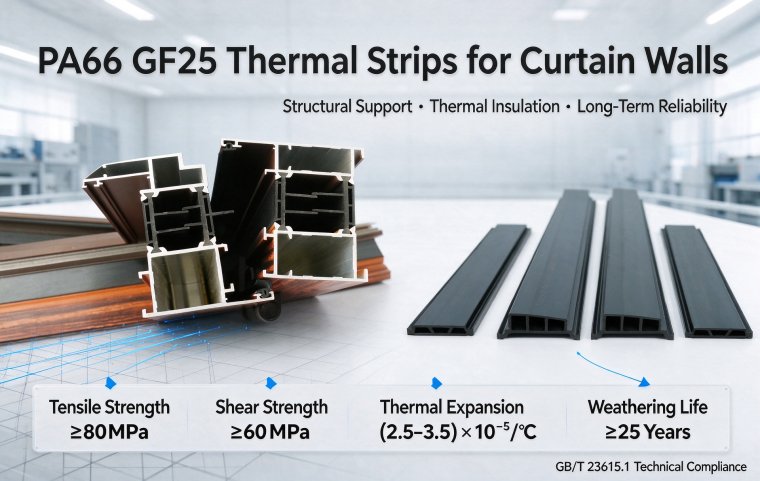
First, PA66 thermal strips for curtain walls need to meet higher performance standards. According to GB/T 23615.1 *Thermal Insulating Materials for Aluminum Alloy Building Profiles — Part 1: Thermal Strips*, PA66 GF25 thermal strips must be adopted for curtain wall works. Their longitudinal tensile strength at room temperature shall be no less than 80 MPa, and the thermal expansion coefficient shall be controlled within the range of (2.5–3.5)×10⁻⁵/℃ to achieve a good match with aluminum alloy profiles. In addition, curtain wall thermal strips are required to deliver superior creep resistance and fatigue resistance to withstand long-term wind loads, seismic loads and thermal stress on curtain walls, so as to guarantee structural safety.
Second, the cross-sectional design of thermal strips shall match the curtain wall profiles. Curtain wall profiles feature complex cross-sections. Thermal strips shall be custom-designed according to the groove dimensions and force directions of profiles to secure the connection strength after mechanical assembly. Common cross-sections for curtain wall thermal strips include I-shape, C-shape and T-shape. They shall be tightly combined with aluminum profiles by the strip-insertion process, with the shear strength after assembly reaching no less than 60 MPa to prevent separation during service. Meanwhile, the cross-section of thermal strips shall maintain the integrity of the thermal insulation cavity to maximize thermal insulation performance.
In terms of installation technology, the assembly of PA66 thermal strips for curtain walls requires professional strip-insertion equipment to ensure assembly accuracy. During assembly, the grooves of aluminum profiles shall be kept clean and free of oil stains and impurities, which may otherwise impair bonding strength. The insertion speed and pressure shall be uniform to avoid deformation or damage to thermal strips. After assembly, shear and tensile tests shall be carried out to verify that the bonding strength meets standard requirements.
Weather resistance assurance is critical for the application of curtain wall thermal strips. Exposed outdoors for a long time, curtain walls are subject to ultraviolet radiation, rain, wind-blown sand, high and low temperatures and other environmental conditions. Therefore, PA66 thermal strips for curtain walls shall be blended with additives such as UV stabilizers and antioxidants to improve aging resistance. Moreover, they shall pass damp-heat aging, UV aging and other tests to maintain stable performance in harsh environments and achieve a service life consistent with that of the curtain wall (normally ≥ 25 years).